
CREATE DEMAND · META ADS
Make the offer familiar before the search begins.
Your buyers scroll personal feeds long before they type a supplier name. If the first time they meet you is the search, a competitor already feels safer. Mplan uses Meta Ads to put a recognizable business idea in front of a broad professional market, then lets the creative do the targeting. Tests compare problem frames, propositions and proof.




On this page
















Desired change
Recognize
Make the right buyer see their problem, priority or situation in the creative even when delivery is broad.
Build
Move from first exposure to proof, comparison and a stronger reason to engage, rather than repeating the same introduction.
Learn
Use response patterns to understand which problems, propositions and proof resonate. Carry that learning into the wider go-to-market plan.
Turn broad delivery into relevant demand.
Meta does not need to know a buyer’s exact job title to influence them. The opportunity is to put a specific commercial idea in front of the market, build recognition through repeated exposure, and learn which messages create meaningful response.
Capabilities
Recognition first. Response only when the person is ready.
Recognition first, response only when the person is ready, so the right professional feels the problem on screen is theirs and the lesson from the feed travels. This is paid social for B2B recognition on Facebook and Instagram. The platform now prefers broad delivery through Advantage+, and professional identity is inferred from behavior rather than declared. Accept that, and the channel makes sense: the creative is the targeting. Reject it, and you will keep building audiences the delivery system will ignore.
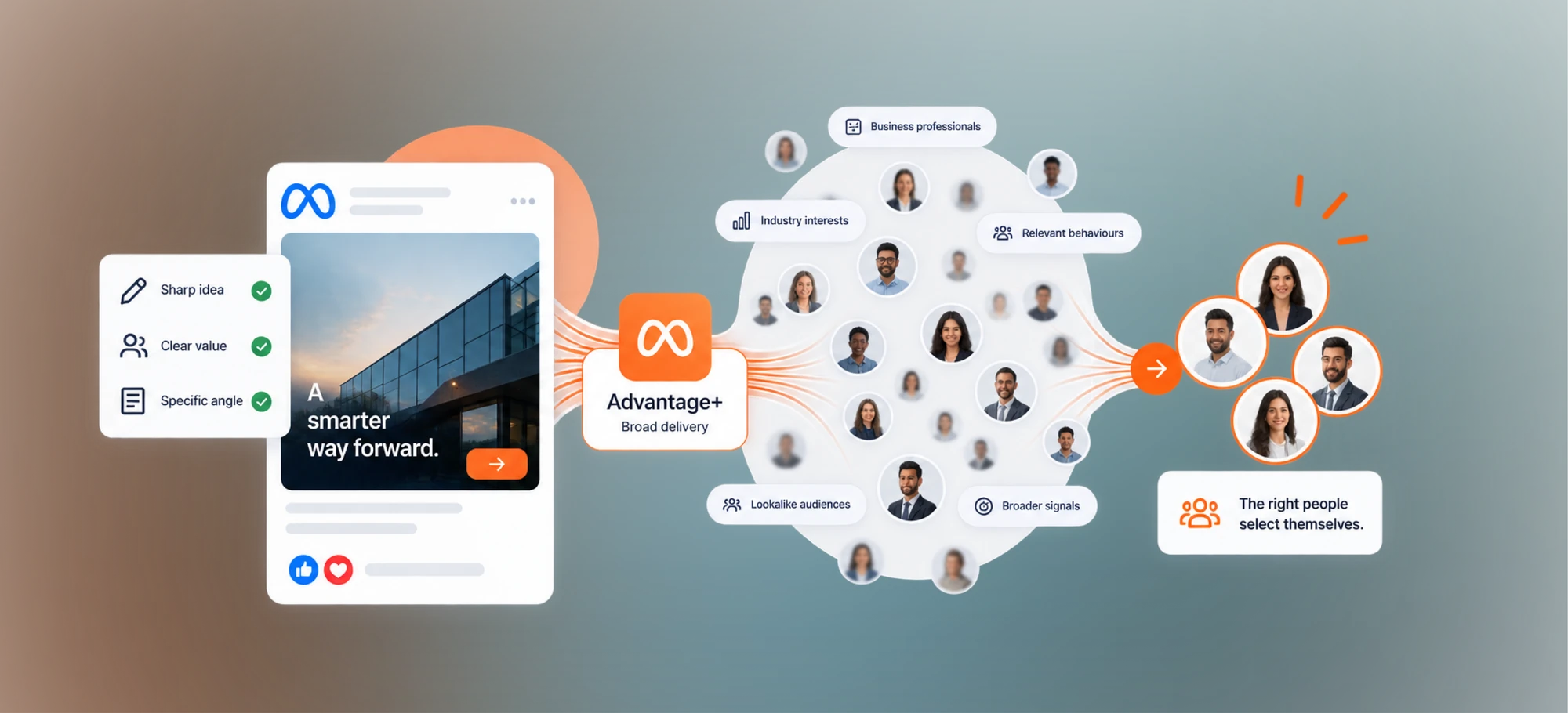
We plan for Advantage+ rather than against it. The audience is a plausible professional market, not a fantasy of title-level precision. If the idea could have been written for anyone, Meta cannot save it. If the idea is sharp, the right people select themselves.
A useful test changes the argument: problem frame against problem frame, proposition against proposition, proof choice against proof choice. We write the hypothesis before the flight. The winner has to teach something you could put on a landing page.
A first exposure introduces the tension. A returning viewer should get the next chapter: proof, comparison, or a clearer offer. Frequency without new information is how B2B buyers learn to skip you.
An instant form is right when the request is modest and the context already lives in the ad. A landing page is right when a considered offer needs room for proof. Friction is not a moral failure. It is how you separate curiosity from commercial fit.
The response path earns the next step.
Meta can introduce a relevant idea before search begins. Audience design limits waste, while the creative and destination determine whether attention becomes useful interest.

Recognisable problem
One idea that earns attention

Plausible audience
A reachable group, not false precision

Proportionate response
A form or page suited to readiness
Decision context
What Meta can honestly do for a B2B plan.

The feed is personal. The targeting is not a job title
Meta will show your ad next to family photos and football clips. That is the point. The buyer is off the clock, not sitting in a vendor evaluation. If the idea cannot earn a pause in that setting, tighter interest lists will not rescue it. You may have this problem if:
- Meta is treated as a cheaper LinkedIn, with the same account list forced into inferred audiences.
- Interest stacks and lookalikes keep getting tighter while Advantage+ keeps broadening delivery anyway.
- Tests compare crops, colors, and first-three-seconds, and nobody learns which market idea won.
- Instant forms fill fast, and sales cannot tell curiosity from commercial fit.
- A winner stays locked inside Ads Manager and never changes search copy or the website.
- The category needs recognition, and the only ads in market are discount-coded response units.
The cost is a familiar one in B2B. You buy cheap attention, then discover it taught the market nothing you can reuse. The next campaign starts from the same blank argument.










Frame the idea, then let the feed select
Make a B2B offer familiar before buyers start searching. Creative does the targeting. Tests compare market ideas, not crops. Learning travels.

Frame
One market tension the right professional will recognize in a personal scroll.

Test
Competing problem frames, propositions, or proof choices. Not crop tournaments.

Sequence
Next chapter for people who already paused. A different ask by readiness.

Transfer
Take the winning argument into search, pages, and sales material.
The platform will find delivery. The work is making sure it delivers an idea worth remembering. If a test cannot change the company public language, it was production, not research.
From targeting precision to market relevance
Meta offers powerful delivery, not a verified list of B2B decision-makers. Instead of pretending inferred interests and job signals are precise, we use them to reach a plausible market, then let specific creative and meaningful response reveal where the real relevance sits.
| What creates false confidence | What we protect instead | What it tells the business |
|---|---|---|
| Inferred job titles look like known professionals | Treat professional signals as directional, not verified identity | Who Meta may reach is different from who you can prove saw the ad |
| Interest lists look like defined buying audiences | Use interests as delivery signals within a plausible market | An interest can guide delivery; it does not prove commercial intent |
| More targeting filters feel more precise | Give Advantage+ room to deliver within sensible boundaries | Artificial precision should not restrict useful discovery |
| Generic creative relies on targeting to create relevance | Make the problem, proposition and proof specific to the market | The message does more of the qualification work |
| Engagement is treated as proof the targeting worked | Judge which ideas attract meaningful response | Response becomes evidence about what the market cares about |
| Winning ads are treated as campaign results | Carry winning ideas into landing pages, search and sales material | Meta becomes a source of market learning, not an isolated media channel |
What the creative program leaves behind
Depending on scope, the work produces:
The artifacts should make the Meta Ads argument visible even if you never open Ads Manager. A marketing lead should be able to hand the matrix to sales and explain what the market is being taught.
A written job for Meta inside the wider paid plan
Audience design that assumes inferred identity and broad delivery
A creative test matrix of problem, proposition, and proof
Feed and story units built around one idea per test
Instant-form versus landing-page rules by offer type
Retargeting sequence notes
A transfer brief so winners leave the ad account
Reporting that separates attention, response, and later commercial signal
Fit and limits
Readiness decides the response path.

Works best when
Choose the landing page or in-platform response path around the audience’s readiness. Both paths should provide enough context to make the next step informed.

Reconsider when
Keep lead expansion contained while the response path cannot separate curiosity from commercial fit or supply the context a considered buyer needs.
Decision guidance
When Meta belongs in the plan.
Meta belongs in the plan when the professional market is broad enough to reach through inferred signals, creative can name a frustration buyers already feel, and you can act on what a winning idea teaches other channels.

Professional identity is inferred from behavior, not declared the way it is on LinkedIn.
Low-friction responses describe ease rather than confirmed buying intent. The company, the participant and the later conversation describe commercial relevance.
A very narrow account market usually belongs on LinkedIn. Familiarity also needs repeated exposure, not one viral week.
Questions
Questions companies ask before buying the feed.
Why can Meta lead volume look stronger than lead quality?
Low-friction forms make responding easy. The company, the role, the reason for responding, and the later conversation show whether that response carried commercial weight. Cheap leads are often a path problem, not a targeting mystery. If the ad asked for almost nothing, the form will give you almost nothing.
Should the campaign use an instant form or a landing page?
Use the path the audience needs next. A simple request can live in an instant form if the ad already supplied the idea. A considered offer usually needs a page with context, proof, and a clearer choice. We do not pick the form because it is faster to launch.
Is Meta useful for named account lists?
It can keep a broad market warm. It is not a precise ABM replacement. Identity is inferred and delivery is broad. Narrow account lists almost always belong on LinkedIn, where professional identity is declared. Use Meta when the market is wide enough that a sharp idea can find the right people without a list doing the targeting.
When should Meta stay out of a B2B plan?
When the audience cannot be reached responsibly, when creative has no recognizable problem, or when the business cannot use the interest that arrives. Also when the only goal is a short list of named buyers. That job belongs on LinkedIn or outbound, not in a personal feed that cannot promise a title.
What is a real creative test?
Two or more market ideas that could change the company public language. Software that reduces close time versus the hidden cost of your current stack is a test. Two crops of the same line is production hygiene. We run both kinds of work. Only the first one is allowed to claim a strategic lesson.
Can Meta replace search?
No. Meta creates familiarity before the query. Google Ads captures the query. If you turn search off because the feed is cheaper, you abandon people who are already looking. If you run search with no recognition work, you meet buyers after someone else named the category. The channels have different jobs.
How do you keep Advantage+ from wasting spend?
You do not keep it from going broad. You give it an idea only the right buyer would pause on, exclude obvious waste, watch the companies that respond, and kill tests that attract the wrong market. The filter is the message. Fighting Advantage+ with ever-smaller interest piles usually means you wanted LinkedIn and bought Meta instead.