
CREATE DEMAND · PROGRAMMATIC
Buy B2B reach you can inspect and stop.
Most B2B buyers read, watch and listen on the open web for months before they search a supplier. Programmatic is how Mplan buys that earlier recognition: context paired with probabilistic account matching, shortened supply paths, made-for-advertising sites excluded, and separate jobs for display, video and audio. An impression is not a person.





On this page
Desired change
B2B programmatic can deliver scale without enough clarity on what you actually bought.

Unclear inventory
Limited visibility into where ads actually appear.
Frequency waste
Small B2B audiences can see the same ads too often.
Wasted impressions
High delivery numbers do not always mean meaningful buyer exposure.
Low-quality placements
Cheap inventory can consume budget without adding real value.
Audience uncertainty
Account matching cannot confirm that the right decision-maker saw the ad.
Opaque supply paths
Too many intermediaries make spend harder to inspect and control.
Capabilities
Reach you can inspect, verify and control.
This is planned open-web media: display, video, and audio bought through programmatic pipes, aimed at B2B recognition before the search. Context and probabilistic account matching work together, because either label alone is weaker. Transparency is part of quality, not a slide at the end.
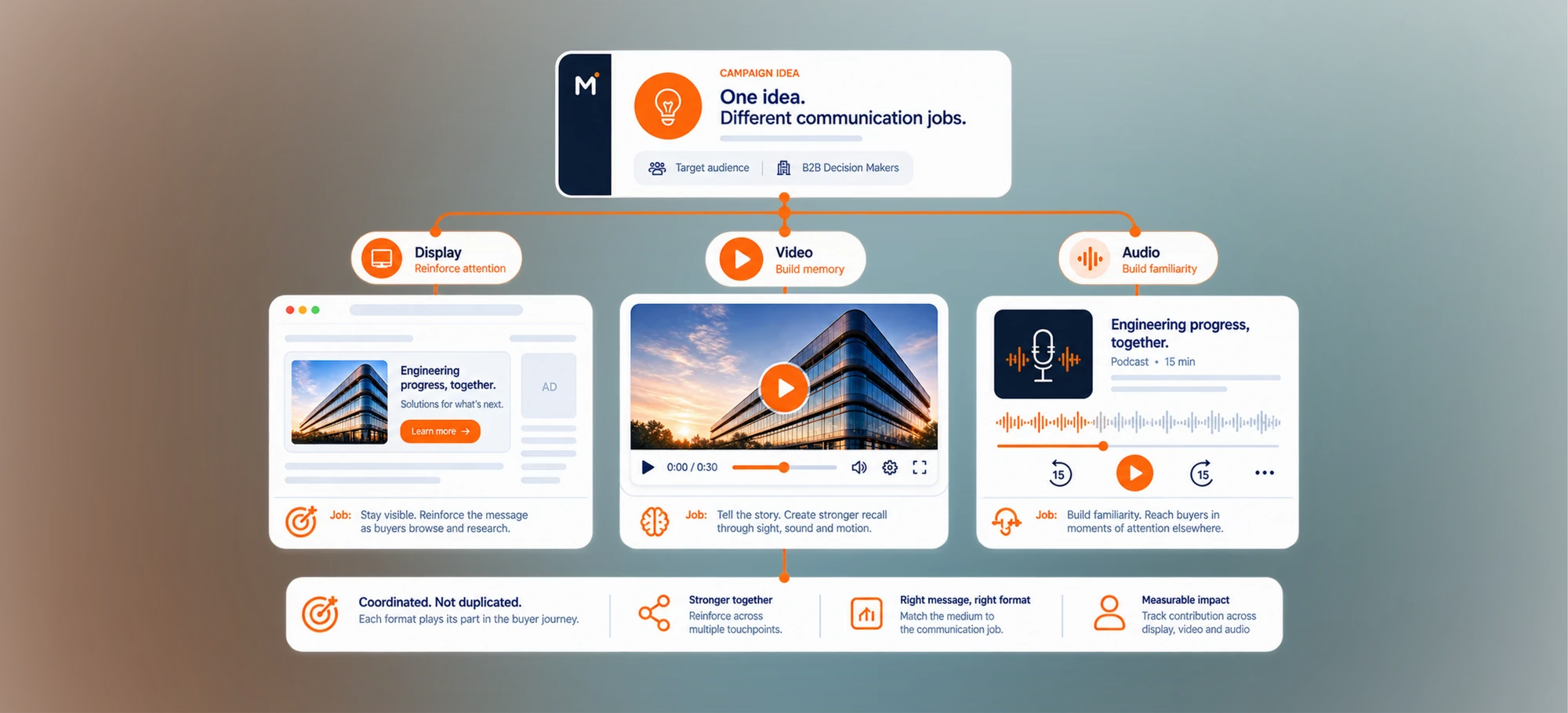
A small display unit reinforces a thought the market has already met. Video builds memory. Audio can do the same in a commute or a specialist show. Repeating one asset everywhere ignores why each environment was chosen.
Company and role signals can raise the chance of a relevant exposure. They remain probability, not a verified viewer list, and we will not write the plan as if they were. If the reachable market is too small for repeated exposure without over-frequency, programmatic is the wrong tool.
A respected trade publication or a relevant streaming environment places the brand beside work the buyer is already doing. Familiarity should have a reason behind it: the company kept appearing around a relevant idea, not because the same unit followed someone across junk.
Between your budget and a publisher sits a chain of exchanges and resellers. We shorten that chain, favor curated deals we can inspect, and exclude made-for-advertising inventory. The ANA documented that as a quality problem in 2023.
The buying route should stay understandable from market to publisher.
Automation may connect several technology and supply relationships. A responsible plan makes each decision visible enough to judge what was bought and why.

Market basis
Accounts, professional audiences or relevant contexts

Buying route
A transparent path through selected supply

Publisher environment
Inspectable placements with a credible chance of attention
Decision context
You bought reach. You cannot see where it landed

Open-web media fails quietly. The report still loads. The logo still appears somewhere. The somewhere is the problem. If the team cannot name the publication, the path, or the format job, you do not have recognition media. You have leftover inventory with a B2B label. You may have this problem if:
- Display or video reports millions of impressions and no one can name the publishers.
- The DSP says the ads reached target accounts, and the screenshot is treated as a person list.
- Made-for-advertising sites sit in the placement report, if anyone opens the placement report.
- The same banner runs on display, in-stream, and audio as if those formats shared a job.
- Frequency looks fine at the campaign level and savage inside the actual account set.
- Stopping a placement requires a ticket, a week, and a vendor explanation.
The cost is not only wasted impressions. It is a brand that appears in rooms it would never choose, while leadership is told the open web is working. That story lasts until a finance lead asks for the placement list.


























Define the market, then buy only what you can see
Programmatic should build recognition in environments your buyers already trust. Start with a defined market, control where the brand appears, and scale only when the inventory earns it.

Define
Set the accounts, professional audiences and contexts worth reaching.

Inspect
Check supply paths, placement quality, brand suitability and MFA exclusions before spending at scale.

Place
Use display, video and audio for distinct jobs, with frequency controlled around the real audience.

Stop
Remove inventory you cannot defend. Keep reach, inferred influence and commercial outcomes clearly separated.
Recognition before search, on inventory you can stand behind
Programmatic is demand creation across the open web, not a cheaper version of LinkedIn or proof that a named buyer saw an ad. Account matching can concentrate delivery, while transparent inventory and clear controls make that reach more defensible.
What a defensible open-web buy leaves on file
Depending on scope, the work produces:
These files should let a skeptical finance lead follow the programmatic spend. A DSP login is not a substitute for a named path from budget to publisher.
Audience and account-market definition, stated as probability
Publisher and context list with reasons
Supply-path and placement quality sheet
MFA and brand-suitability exclusions
Format-job plan for display, video, and audio
Frequency caps tied to the reachable audience
Landing continuity notes for early-stage interest
Stop rules and a readout that names where money went
From open-web volume to reach you can defend
Access to the open web is easy. The challenge is knowing where your media appeared, how it got there, and whether the impression was worth buying. The shift is from chasing volume to building programmatic around visible inventory, credible contexts and clear controls.
| Typical programmatic | Where it falls short | Inspectable programmatic |
|---|---|---|
| Maximize impressions | Volume does not guarantee meaningful exposure | Choose environments worth appearing in |
| Trust the DSP report | Publisher and supply-path visibility can remain unclear | Inspect publisher, placement and supply path |
| Accept inventory when CPM is low | Cheap reach can hide MFA and poor-quality placements | Exclude MFA and prioritize quality by design |
| Run one asset everywhere | Display, video and audio are treated as the same job | Give each format a defined role |
| Treat account matching as identity | A match does not prove a named buyer saw the ad | Treat matching as probability, not identity |
| Manage frequency at campaign level | Small account sets can become overexposed | Control frequency around the real audience |
| Accept hard-to-change media plans | Poor inventory can continue consuming budget | Build clear stop rules into the buy |
Fit and limits
Early attention needs somewhere useful to go.

Works best when
Give the post-click experience a recognizable campaign idea, enough depth for early consideration and a next step that respects the visitor’s stage.

Reconsider when
Use a more precise channel when the reachable market is very small, the destination has no relevant continuation or early attention would be reported as sales readiness.
Decision guidance
When programmatic earns a place in the plan
Programmatic works when the market is large enough for repeated open-web exposure and the media can be bought with clear controls over where it appears, how it is delivered and what can actually be measured.

Brand suitability
Choose environments worth appearing in, with clear allowlists, exclusions and placement controls.
Media-quality evidence
Keep visibility into publishers, placements, supply paths, viewability and fraud signals.
Controlled reach
Build enough exposure to create familiarity without repeatedly hitting the same small account set.
Honest measurement
Treat impressions as opportunities to see and account matching as probability. Neither proves that a named buyer saw the ad or caused a later sale.
Questions
Questions companies ask before committing to open-web reach.
Can programmatic reach a named account precisely?
Account and identity matching are probabilistic. They can concentrate delivery around a market. They do not establish that a particular person saw an ad. Reporting should keep that distinction, even when a vendor slide wants to erase it.
How do you judge inventory quality?
Placement visibility, publisher context, supply path, viewability, fraud controls, and brand suitability. A smaller set of understandable environments can create more confidence than nominal access to the entire open web. If we cannot name the placement, we should not be buying it.
What audience size is too small?
When the reachable market cannot support meaningful reach without over-frequency, another channel usually spends the same attention budget better. Programmatic needs enough market for repetition to be useful rather than annoying.
When is LinkedIn a better use of the same money?
When professional role precision and account concentration matter more than broader open-web familiarity. LinkedIn uses declared identity. Programmatic uses context and probability. They can support each other. They do not do the same job.
Why exclude made-for-advertising sites if some of it looks cheap?
Because those sites exist to harvest budget, not to hold attention beside serious work. The ANA flagged made-for-advertising inventory as a documented quality problem in 2023. Cheap inventory that nobody chose to read is not a bargain. It is a leak.
Do display, video, and audio need different creative?
Yes. Display reinforces. Video and audio build memory. Native can carry more context. Forcing one asset through every pipe wastes the reason you selected the environment.