
PROGRAMS · WEBSITE DEVELOPMENT
Fix the website before you send more buyers to it.
Your search, LinkedIn, and outbound campaigns all land on the same site. If a page loads slowly on a phone, says something different from the ad, or sends the inquiry to a mailbox nobody checks, more spend sends more buyers into the same hole. We find the holes, fix them, and prove the fix. Most sites do not need a rebuild.
On this page
Desired change
A site you can safely send buyers to.
A buyer arrives from a search result, an ad, or a sales email and finds the offer they were promised, proof for their role, a next step for their stage, and a person who replies knowing what they came for. Each of those is tested, not assumed.
Capabilities
What the website program actually covers.
The Mplan Buyer Continuity Protocol is our name for one habit: follow the buyer from the first click to the sales reply, and fix whatever breaks on the way. The work is still web work: pages, forms, speed, tracking, a CRM. The difference is that each piece is tested against the campaigns that feed it.
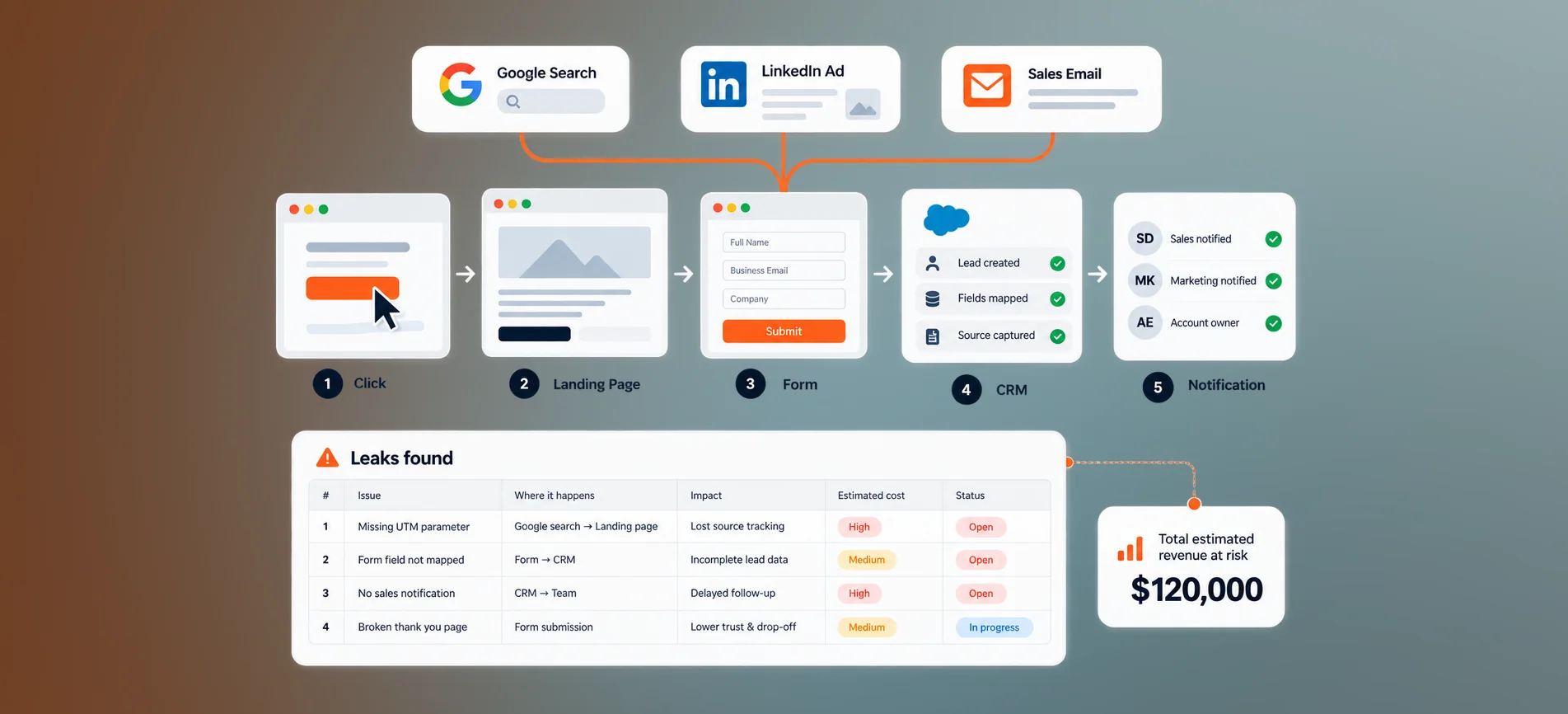
We take your top routes, say a Google search, a LinkedIn ad, and a sales email, and walk each one the way a buyer would: click, page, form, reply. We submit the form ourselves and check where it lands, which fields reach the CRM, and who is notified. Every leak goes on a ranked list with what it costs you.
We line up the ad, the landing page, and the sales deck and remove the differences. Then we put proof next to the claim it supports: a client name with permission, a number with its source and date, a screenshot of the real product. The user, the evaluator, and the budget owner each get something written for them.
Our team designs and builds where the evidence calls for it: one landing page, a form route, a consent setup, a WordPress or Webflow rebuild, or nothing at all. Every release is checked for security headers, indexing, speed on a mid-range phone, accessibility, form delivery, and rollback, on staging and again on production.
We set up Google Tag Manager, GA4, and the consent banner so they do what the banner says, and each event gets one meaning. Campaign source and landing page travel into HubSpot, Salesforce, or Zoho with the lead. Every inquiry reaches a named person with a reply time, and the outcome comes back to marketing.
Decision context
What changes, and how you will know.

Buyers test the site before sales gets a meeting.
You may have this problem if:
- Paid campaigns point at pages nobody has opened on a phone.
- The ad, the page, and the sales deck describe three slightly different offers.
- Page views, company matches, and form fills are reported as if they mean the same thing.
- Inquiries arrive with no campaign source, no owner, or no reply.
- Sales says the leads are weak, and marketing says sales never follows up.
- Nobody can say whether the site is safe to receive more spend.
The damage is not only lost inquiries. Every channel report looks fine, because every channel did its job, so the leak never gets a budget line.
From a site that is assumed to a site that is tested.
The work is still web work. What changes is that every piece is checked against the campaigns that feed it.
| Today | What this program adds | Desired state |
|---|---|---|
| Campaigns are checked, the site is assumed | Every route walked from click to reply | The site is tested before spend is added |
| Ad, page, and sales deck describe three offers | One argument and one proof set, used everywhere | Buyers meet the same company everywhere they look |
| One page for every visitor | Proof matched to the user, the evaluator, the budget owner | Each role finds its own answer |
| The site looks fine on the founder’s laptop | Speed, forms, and layout checked on a mid-range phone | The site works where buyers open it |
| Page views, company matches, and form fills counted together | Three separate signals with agreed meanings | Reports say what actually happened |
| Inquiries arrive with no context | Campaign source and page travel into the CRM with the lead | Sales knows what the buyer came for |
| Someone replies, eventually | A named owner and a reply expectation | Buyers hear back, and marketing hears the outcome |
| Redesign every three years | Fix what the evidence shows, keep what works | Spend goes to the leak, not the look |
This is not a redesign program. It is the work of making sure the promise in the campaign survives the visit.
A Gartner survey of 632 B2B buyers, published in June 2025, found that 69% had met inconsistencies between a supplier’s website and what its sellers told them. 6sense’s 2025 Buyer Experience Report, a vendor study of about 4,000 buyers, found the winning vendor was already on the first shortlist in 95% of purchases. Buyers form a view before most companies know a decision is under way. That is why Mplan tests the site against the campaigns before scaling either one.
Eight checks
Eight things we check before you add spend.
Any one of these can undo everything else, so they come first.

- Security No serious weakness on the live site.
- Indexing Production is open to search engines, and staging is not.
- Availability The pages campaigns point at load, with no linked 404s.
- Forms and routing A test submission reaches a named person.
- Consent The banner does what it says, and tracking respects it.
- Analytics The numbers can be trusted for a decision.
- Mobile Speed and layout pass on a mid-range phone.
- Ownership Someone is accountable for every inquiry.
If one fails, it gets fixed before anything else is scaled. The Programs page explains the method behind the checks.
How it runs
From click to reply, in four steps.
The first step decides how much of the rest you need. Most sites need less than they expect.
Trace
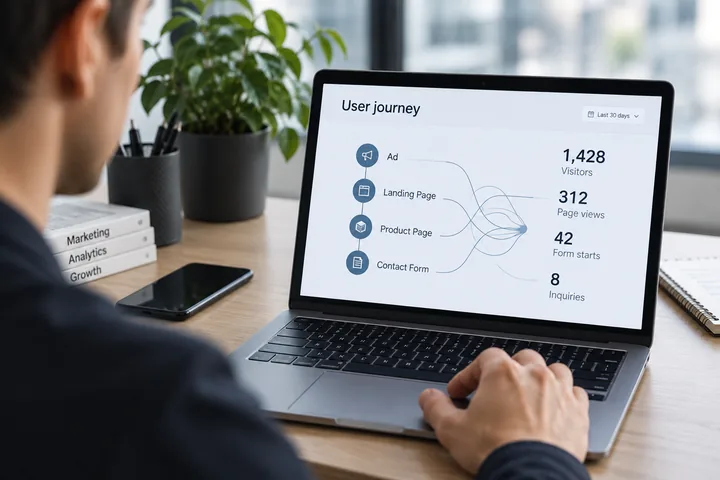
Walk every route a buyer takes. List the leaks by cost.
Fix
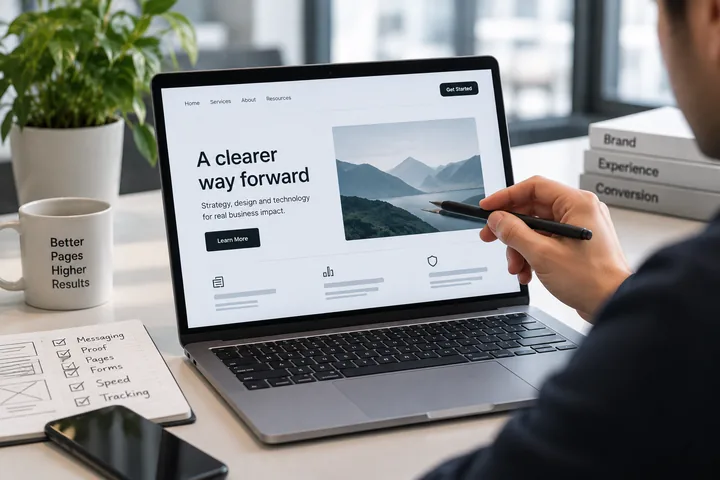
Message, proof, pages, forms, speed, tracking, in order of evidence.
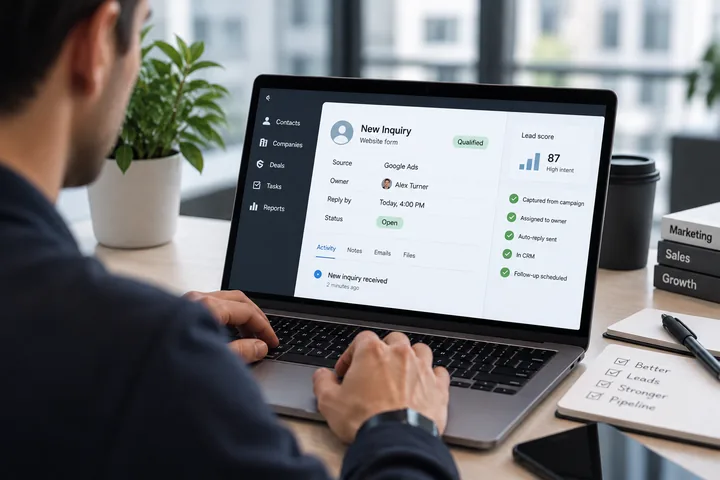
Connect
Context into the CRM, a named owner, a reply time, the outcome back to marketing.
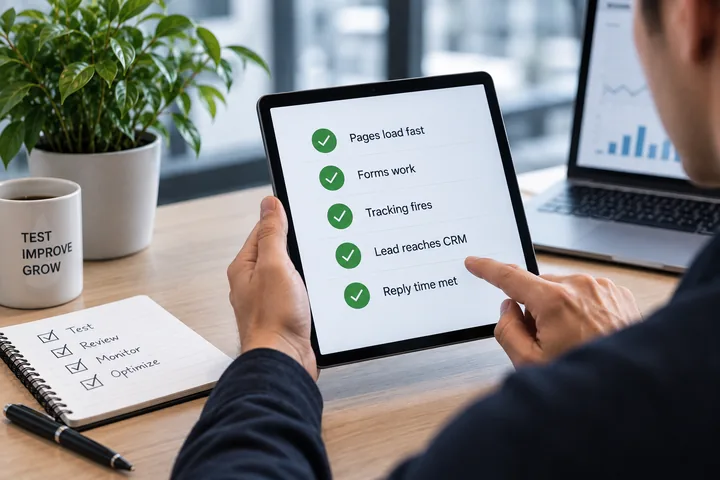
Verify
Retest on production, then keep watching.
What the website program leaves you holding.
Depending on scope, the work produces:
These are pages, settings, and test records you can inspect. Not a slide that says conversions improved.
Route map from click to reply, per campaign
Ranked leak list with the cost of each
Message alignment across ads, pages, and sales decks
Proof map by buying role
Claims and permissions record
Landing pages and page rebuilds
Form, routing, and CRM field setup
Google Tag Manager and GA4 implementation
Consent banner configuration
Speed, accessibility, and security fixes
Go-live checklist, signed off on production
Quarterly retest report
Fit and limits
When the website deserves the next decision.
Works best when
The offer is established, campaigns or account outreach already depend on the site, leadership wants evidence before a redesign or a bigger media budget, and marketing and sales will share definitions and report what happened to each inquiry.
Reconsider when
The offer changes every month, nobody can approve a change to the site or the CRM, sales will not own inquiries, or the request is for a better-looking site with no commercial question behind it.
We do not guarantee rankings, conversions, pipeline, or revenue, and we do not identify anonymous individual visitors.
Questions
Questions companies ask before they touch the website.
Do we need a new website?
Often not. We test the site you have. A capable site passes as it stands, and we keep what works. Where a real break shows up, the fix may be a page, a form route, a consent setup, or a rebuild. You will know which, and why, before any build is scoped.
Can you work with our developers or our current agency?
Yes. Our team can make the fixes, or your developers can work from the leak list while we retest. Either way the result is verified on production, with a real submission.
Do you handle Google Tag Manager, GA4, consent, and the CRM?
Yes. That is usually where the first leak is. Each event gets one meaning, the banner does what it says, and campaign source and form answers reach HubSpot, Salesforce, or Zoho with the lead. Then we test it on production, not on staging.
Will this pause our campaigns?
No. Campaigns keep running while we trace them. If we find a leak that is wasting spend today, such as a form that reaches nobody, we tell you the same day and fix that first.
Can you tell us who is visiting our site?
At company level, sometimes, with a stated confidence. At person level, only when someone identifies themselves. Anonymous visits, inferred companies, and known people stay three separate kinds of evidence. A page view is not a lead.
Is this a one-off project or a retainer?
Two levels. The Minimum Program fixes what fails the eight checks and gets the site to a verified condition. The Performance Program runs after that: weekly signal review, pages for priority accounts, tests where traffic allows, a quarterly retest. The review decides which you need. Minimum is not a budget tier, and Performance is not a bigger build.
How do you measure the work?
From a declared baseline: the original condition, the change and its release date, the result, and the other explanations. For speed we use Google’s Core Web Vitals at the 75th percentile: LCP at or below 2.5 seconds, INP at or below 200 milliseconds, CLS at or below 0.1. Those describe the buyer’s experience. They do not guarantee rankings or conversions.
How long does it take?
The review has a fixed scope and ends in a decision. What follows depends on what it finds, so the timeline is set after the decision. A failed check is fixed first, whatever else is planned.
We're a US company. Can you fix or rebuild our site from India?
Yes. We start with the conversion path and message clarity for your buyers, then implement from Bangalore with clear milestones. You get a site sales can trust, not a redesign for its own sake.