
DEVELOP PRIORITY ACCOUNTS · B2B LEAD GENERATION
Send sales conversations it will actually use.
Marketing can fill a CRM. Sales still has to decide which of those names deserve an hour. Mplan treats a qualified conversation as the unit of progress: a fitting account, a participant who can influence the decision, and a reason both teams already recognize. That definition is written and agreed before the first campaign.
On this page

Your commercial team is spending its week sorting, not selling. Marketing reports contacts while sales reports time lost on companies it would never pursue.
Desired change
Make the qualified conversation the unit of progress.

Make the qualified conversation the unit of progress, so both teams recognize the same useful conversation and refuse the rest without argument.

Capabilities
What B2B lead generation at Mplan actually covers.
This work turns a defined market into conversations sales will take. Not a rented list. Not a monthly contact quota. You start with a written definition of a valuable account and a qualified conversation, then choose the route, hand the response to a person with context, and use what sales accepted or refused to sharpen the next month.
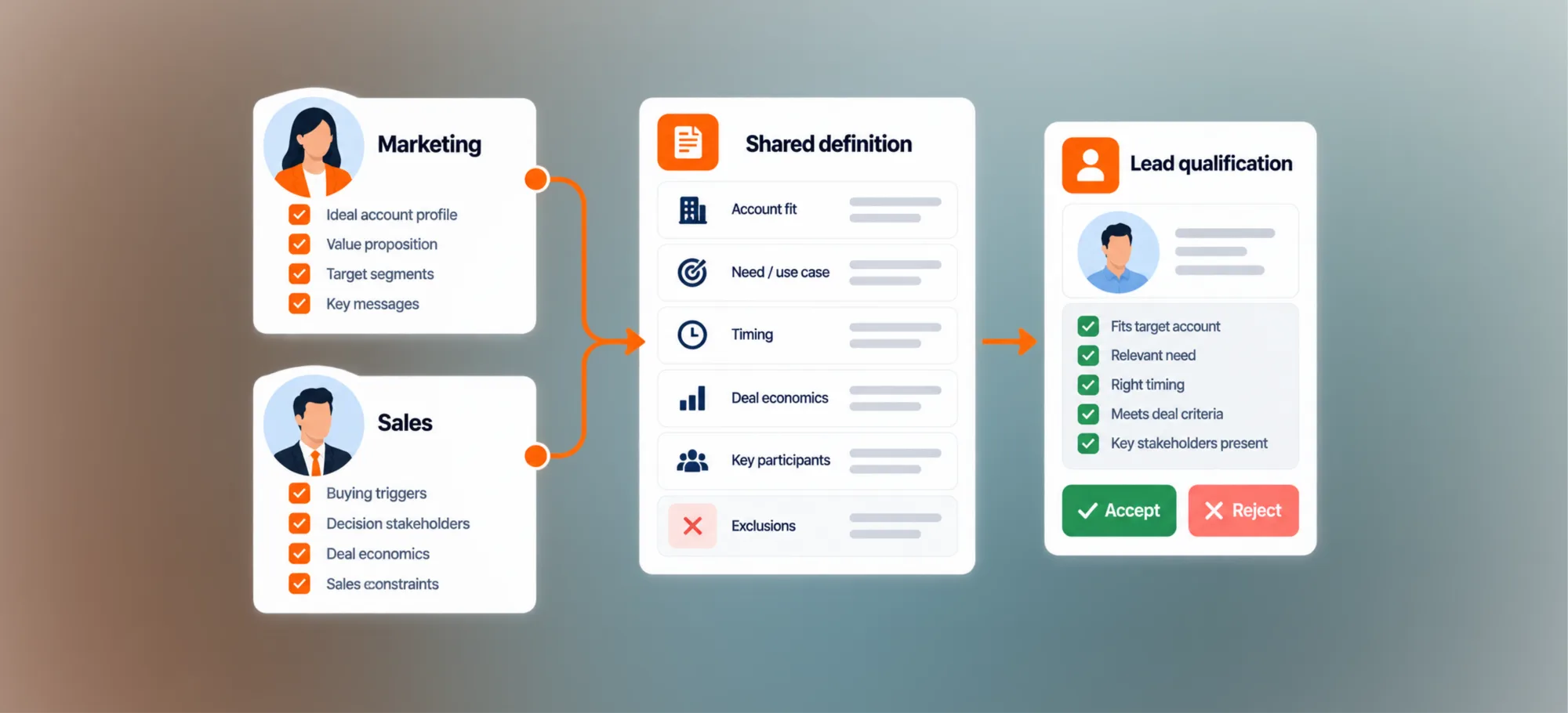
Before campaigns, both teams write what a valuable account is and what a qualified conversation is. Fit, need, timing, deal economics and who must be in the room go on the page, and so do exclusions. If the definition cannot reject a lead, it is not finished.
The list comes from offer economics, win history, operating conditions and known buying triggers. Third-party intent data is a pointer, never proof. It is account-level, noisy and behind real time.
An account already researching may need search visibility and a short path to a conversation. A suitable account that has not recognized the problem yet needs education first. The routes can support one another. They do not have to start together.
A response arrives with the company, the participant, the message and the reason for interest, so a person who understands the offer continues while the interest is still warm. Starting from zero is how a relevant reply becomes an abandoned record.
A market definition becomes valuable when a person can continue the conversation.
Account selection concentrates attention. Relevance gives a participant a reason to respond. A prepared commercial owner turns that context into a useful discussion.

Suitable accounts
A market sales can recognise

Relevant attention
ABM or outreach matched to context

Human conversation
A thoughtful continuation by the commercial team
Decision context
What disciplined lead generation asks of both teams.

Sales is spending its week sorting, not selling
You may have this problem if:
- Marketing reports contacts, MQLs, or form fills while sales reports time lost on companies it would never pursue.
- The same names recycle through the CRM because nobody agreed what qualified means in writing.
- Intent scores, webinar lists, and content downloads are treated as proof of buying, then collapse on the first call.
- A response hits a generic queue, and the person who answers does not know what the account saw, who spoke, or why they replied.
- Targets rise each quarter even though the commercial team cannot absorb last quarter volume with care.
- Founders or senior sellers still have to re-qualify every hot lead before anyone will take it.
The commercial cost is not a thin pipeline. It is a team that stops trusting marketing, then stops following up. Once that happens, even a good reply arrives late and half-prepared.










Define, create, hand off, learn

Agree
Write the valuable account and the qualified conversation. Get both teams to sign the same page.

Choose
Pick the route that fits account state, value, and evidence. Do not start every motion at once.

Hand off
Send every response with context a person can use. Own the first continuation.

Return
Feed accepted, refused, and learned back into the definition and the list.
The sequence is fixed. The mix of account, outbound, and inbound routes is not. You do not start every motion at once to look complete.
From contact volume to conversations worth pursuing
More contacts do not automatically mean more pipeline. The shift is to define what a valuable account and qualified conversation look like before generating demand, then carry that definition through targeting, qualification, handoff and sales feedback.
| Contact-led lead generation | Conversation-led lead generation | What changes commercially |
|---|---|---|
| Success starts with lead volume | Success starts with a shared definition of a qualified conversation | Marketing and sales judge demand against the same standard |
| Anyone who responds becomes a lead | Fit, need, timing, deal economics and participants determine qualification | Response is separated from genuine commercial potential |
| Targeting starts with available audience data | Priority accounts come from commercial fit, win history and buying conditions | Effort concentrates on companies worth winning |
| Intent data is treated as buying evidence | Intent is used as a directional signal alongside stronger account evidence | Noisy signals inform prioritisation without becoming proof |
| Every account enters the same journey | The route changes according to the account’s current state | Active researchers can move toward conversation while earlier-stage accounts receive education |
| Sales receives a name and contact details | Sales receives the company, participant, message and reason for interest | The conversation continues with context instead of restarting from zero |
| Campaigns maximise the number of leads produced | Volume is matched to the team’s capacity to respond properly | Demand generation does not create more opportunities than sales can realistically handle |
| Rejected leads disappear from reporting | Sales acceptance, rejection and conversation learning feed back into the system | Each cycle improves account selection, qualification and messaging |
What the program puts in writing
Depending on the starting point, the work produces:
These are documents and operating rules you can inspect. If a deliverable cannot change how a response is judged or handled, it does not belong in the pack.
A written account and qualification definition, with exclusions
A handoff brief the commercial owner can act on
A priority-account list and the rationale behind it
Response ownership and timing rules
Route recommendations by account state
A monthly review of accepted, refused, and learned conversations
Campaign and conversation design for the chosen routes
A revised list and definition when the evidence changes
Fit and limits
The handoff decides what the conversation becomes.

Works best when
Prepare the human handoff before creating more conversations. The person responding should understand the offer, read the context and continue the discussion with care.

Reconsider when
Keep demand creation within the volume the commercial owner can answer with care.
Decision guidance
When lead generation earns investment.
Lead generation deserves the budget when sales already knows a good conversation when it hears one, both teams will put a definition in writing and use it to refuse work, and someone owns the human response with time to give it.

A contact becomes valuable only when the account, participant and reason for conversation align. Contact volume is a constraint, not a KPI.
The quality of the commercial response shapes what happens after marketing creates interest. Contact counts, download volume and unverified intent scores are activity, and never appear here as results.
Small or sensitive markets often reward a more selective approach. Judge the program by accepted conversations over a meaningful window, not a campaign week.
Questions
Questions companies ask before setting a lead target.
What makes a B2B conversation qualified?
The company fits the written market. The participant can influence the decision. There is a relevant reason to talk now. A content download or an intent score is not enough on its own. If marketing can mark a lead qualified without sales being able to explain why, the definition is still a slogan.
Do you sell leads as a volume product?
No. The work aims at qualified conversations the commercial team welcomes. Raw volume without fit is treated as a problem, not a success metric. A brief whose only target is more leads, with no account standard and no owner for the reply, is a sorting project. That is not this service.
How do marketing and sales agree the definition?
In a working session, on a page both teams keep. It names inclusion, exclusion, the participant, the reason for conversation, and what happens when a response arrives. That page is tested against recent wins, losses, and wasted follow-up. If it cannot reject last month junk, it is not ready to govern next month campaigns.
What sales capacity should be ready before demand expands?
Someone with clear ownership, enough time to respond while interest is warm, and the judgment to separate curiosity from a useful opportunity. If that person is already at capacity, creating more conversations only trains buyers to wait. Capacity is a design input, not a later complaint.
How do ABM and outbound sit inside lead generation?
They are routes, not separate religions. Account-based marketing concentrates research, media, and senior time on a finite set of accounts. Outbound creates a direct path to a participant when there is a truthful reason to contact them now. Both must share the same account definition and the same handoff, or the buyer meets two companies with one logo.
What does intent data actually tell you?
That a vendor observed account-level research on topics it tracks, with delay and noise. It can point research toward a company that may care. It does not prove a buying process, a budget, or the right participant. An intent score does not override the written definition. It is a pointer. It never proves.
How do you measure this if volume is not the scoreboard?
By conversations that meet the definition, by sales acceptance and refusal, and by whether the list gets cleaner. Activity metrics stay visible so cost and capacity remain honest. They do not stand in for commercial usefulness. If sales would not take the conversation again, it does not count as progress.