
BE DISCOVERED · AI SEO
Enter the shortlist before buyers reach your website.
B2B buyers build shortlists across Google, AI Overviews, ChatGPT and Perplexity before visiting your site. Mplan makes your expertise easier to find, understand and cite across these platforms. It also measures what gets discovered.
On this page
Also called
AI SEO, also called GEO or AI search optimization
AI SEO, GEO (generative engine optimization) and AI search optimization are three names for the same work.
Each means making a company easy for Google and AI answer engines to find, understand and cite.
The name on the proposal changes; the job on this page does not.

Desired change
Become visible while the shortlist is still forming.
Make that expertise discoverable, quotable, and corroborated wherever the research actually happens, so you enter consideration while the shortlist is still forming.
Capabilities
What AI SEO at Mplan actually covers.
AI SEO is the discipline of making a B2B company easy to retrieve, understand, and cite across classic search and AI answer systems. The foundations are still SEO: crawl access, indexation, architecture, and useful pages. The discovery surface has expanded. We treat Google, AI Overviews, ChatGPT Search, and Perplexity as related surfaces with one program and separate observations.
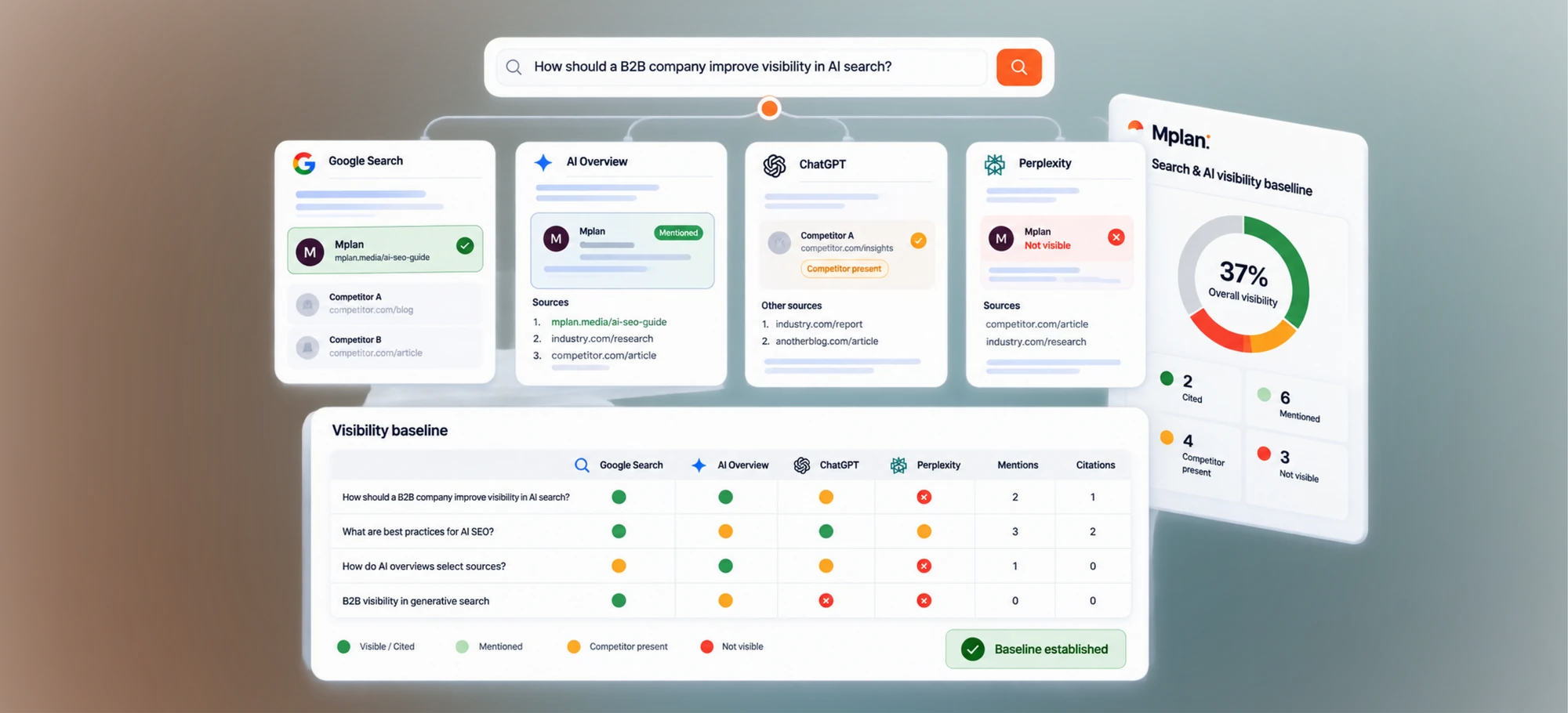
We record what the company appears for across Google, AI Overviews, ChatGPT Search, and Perplexity. The question set is agreed in advance, and every observation logs the question, the engine, the location, and the date.
Shortlists form around comparisons, alternatives, cost, risk, implementation, and vendor selection. Your subject experts supply the knowledge and the byline. We shape the question, the answer, and the evidence.
Your website is one witness. We pursue editorial mentions, expert commentary, and contributed pieces that say something original. We do not buy links, because cheap volume reads as spam to the systems this work is trying to convince.
Search behavior changes by market. We adapt the question set, content and technical structure to the locations and languages you serve, keeping crawl access, indexation and canonicalization clear. Local relevance and international reach are reviewed against the same agreed evidence.
Decision context
What changes, and how you will know.
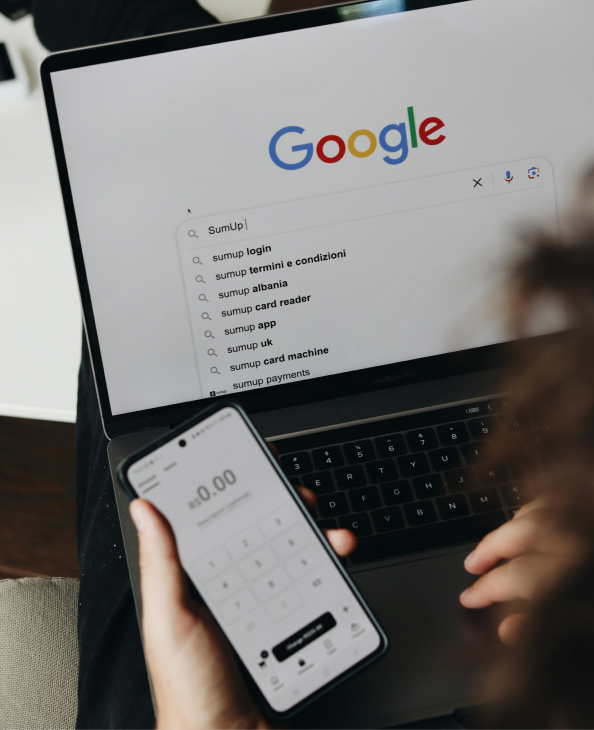
Your buyers are researching before they identify themselves
You may have this problem if:
- You rank for your own name and disappear from category questions.
- Competitors get named in AI answers when your company does not.
- The strongest expertise lives in people, decks, and calls, not in pages a machine can quote.
- Organic traffic exists, but it does not make the firm feel like the authority.
- Prospects arrive already fluent in a competitor story.
- Sales keeps answering the same comparison, risk, and implementation questions that the website never published.
The damage is not only fewer visits. It is entering consideration after the shortlist has already formed.
From invisible expertise to a source worth citing
Traditional SEO remains the foundation. The discovery surface has expanded.
| Traditional SEO foundation | What this work adds | Desired state |
|---|---|---|
| Expertise sits inside people | Expertise is structured around buyer questions | Expertise is findable and citable |
| Search captures known demand | Buyer questions expand discovery | Search also builds consideration |
| Pages describe services | Pages answer buying questions | Buyers find useful answers during research |
| Rankings are the scoreboard | Answer visibility is measured alongside rankings | Search and AI visibility are both observed |
| Search results drive discovery | Visibility extends into AI discovery | Buyers encounter you across search and AI |
| Authority lives on your domain | Independent sources corroborate expertise | Authority extends beyond your website |
| Backlinks build authority | Relevant mentions and links add corroboration | Stronger independent credibility |
| Content volume supports traffic | Content is built for source value | More discovery and consideration |
| Buyers discover you late | Content supports earlier-stage research | Buyers encounter you earlier |
AI SEO is not a project to rank inside ChatGPT. It is the work of making the company a clearer, stronger, better-corroborated source wherever B2B research now happens. Ahrefs analyzed 863,000 SERPs and found that only 38% of AI Overview citations also ranked in the top 10 (Ahrefs, 2025). The Princeton GEO study found that pages carrying original statistics, quotations, and named sources gained the most visibility in generated answers, with GEO methods lifting visibility by up to 40% in the engines evaluated (Aggarwal et al., KDD 2024). That is why Mplan brings SEO, authority and AI visibility together.








From readable source to recognized authority
1. Establish. Technical access, baseline, and entity clarity.
2. Build. Useful answers and evidence around the questions that shape the shortlist.
3. Corroborate. Credible references outside the website.
4. Observe. Patterns across search and AI discovery over time.











What discovery work leaves you holding
Depending on scope, the work produces:
Technical search and crawler audit
Expert-led articles and answer assets
Search and AI discovery baseline
Structured data implementation
Internal-linking improvements
Entity and service architecture
Digital PR and authority opportunities
Buyer-question research
Search and AI visibility reporting
Content opportunity map
Existing-content remediation
A prioritized optimization backlog
These are documents, pages, and logs you can inspect. Not a slide that says visibility improved.
Fit and limits
When AI SEO deserves priority.

Works best when
The offer and ICP are clear, buyers research suppliers in search and AI answer systems before they contact sales, the company has real subject expertise people will put their name on, and you are investing for compounding visibility rather than a lead spike this month.

Reconsider when
Positioning is still unresolved, the website has fundamental crawl or index problems that make later work wasteful, the business needs qualified demand this quarter more than authority next year, or there is no expertise or evidence available to publish.
Questions
Questions companies ask before investing in AI SEO.
Is AI SEO different from traditional SEO?
They share one foundation. Classic SEO earns rankings. Answer engine work wins the answer slot on the results page. Generative engine work earns citations inside answers written by ChatGPT, Perplexity, and similar systems. Google still calls all of it search. You fund one program. We watch each surface separately, because they already behave differently.
Can you guarantee ChatGPT or AI Overview citations?
No. Nobody controls those systems. We give retrieval systems what they actually cite: clear passages that answer a real question, original data, named experts, entity signals that resolve who you are, and independent coverage that corroborates it. We track citations with a logged method and report the trend. A guarantee would be a lie.
How do you measure AI visibility?
A fixed set of buyer questions, run against named models and engines on a schedule. Every observation records the question, the environment, the location, and the date. Progress is a pattern across repeated checks. One screenshot is not a result.
Should we allow AI crawlers?
Usually yes, if you want to be discovered. Blocking GPTBot, ClaudeBot, or PerplexityBot removes you from the answers those systems write. We set access open on purpose and monitor it. If there is a genuine reason to block a crawler, we document it.
Does structured data improve AI citations?
Structured data helps machines resolve who you are, what you sell, and who stands behind the words. That is necessary plumbing. The public evidence does not show schema as a reliable lever for citations on its own. We implement it thoroughly and we do not sell it as magic.
Do we need llms.txt?
llms.txt is a proposed index file for language models. It costs little to publish and proves little so far. Google has said it does not use it. We ship it as courtesy and hygiene, never as a growth lever.
Do backlinks still matter?
Yes, when they are relevant, editorial, and attached to something original. Mentions and corroboration now sit beside links, especially in AI answers. We do not buy links and we do not chase volume. Low-value placements teach the wrong systems the wrong lesson.
Can AI-generated content perform in search?
Unreviewed machine output scores poorly against Google E-E-A-T and against what answer systems choose to quote. First-hand knowledge under a named expert scores better. We will use drafting tools. A person remains responsible for the facts, the experience, and the byline.
When should paid demand generation come before AI SEO?
When the business needs qualified conversations this quarter, when the offer is still moving, or when the site cannot yet be crawled cleanly. Discovery work compounds on a stable offer and a readable site. Paid captures demand that already exists and can create familiarity while authority is being built. They are different jobs.
How long before meaningful changes become visible?
Technical access can change in weeks. Indexation, content, and citations move on the timetable of the systems, not the agency. Plan for a meaningful observation window measured in quarters, with earlier leading indicators: crawl health, published answers, entity consistency, and the first logged appearances.