
PROGRAMS · CREATIVE SERVICES
One argument, recognizable across every surface.
A B2B campaign can produce forty banners, six videos, and a landing page and still leave no memory, because each channel wrote its own version of the company. We start with the one thought a buyer should be able to repeat, fix the colors, shapes, and phrases that must never change, and clear every claim and license before media money goes behind the work.
On this page



Desired change
Decide the idea before the sizes.
One argument that survives a search headline and a 30-second film. A set of assets that stay put while executions rotate.
Proof that stays labeled as proof. A license record you can open. Results you can read by idea, not by file name.
Capabilities
What the creative program actually covers.
The Mplan Buyer Continuity Protocol is our name for one habit: the reason to choose you has to stay the same everywhere the buyer meets you. The work is still creative work: briefs, design, copy, film. The difference is that one argument is agreed first, and every format is checked against it.
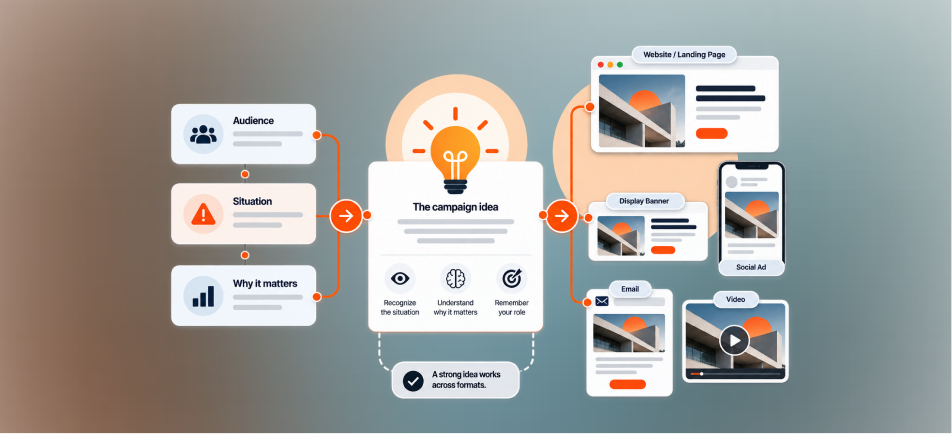
We start with the buyer’s tension, not a list of formats. What situation are they in, why does it matter now, and what is your role in changing it? The output is a one-page brief with the thought a buyer should be able to repeat after one exposure. If the idea disappears when the size changes, execution was carrying the weight, and we go back.
We fix the pieces buyers learn to spot: a color, a shape, a phrase, a way of treating photography and type. Those stay constant for years. Executions wear out, and under real frequency they wear out in weeks, so we rotate them on a plan while the recognizable pieces hold. A new look every quarter resets an introduction you already paid for.
Search copy answers active intent. A LinkedIn feed unit earns a pause. A landing page explains a decision. Film builds memory through sound and pace. We produce each one from the same brief, in the right specification for its placement, and none of them gets to invent a second company. How familiar the audience already is decides how much each asset has to explain.
A client result, a product screen, or a market finding makes the work credible only when it is real and permissioned, so the source and the permission sit on file next to the asset. Fonts, stock, music, talent, and AI-generated material are licensed and recorded, with the term and the territory. Atmosphere is never asked to stand in for a fact you do not have.
Decision context
What changes, and how you will know.
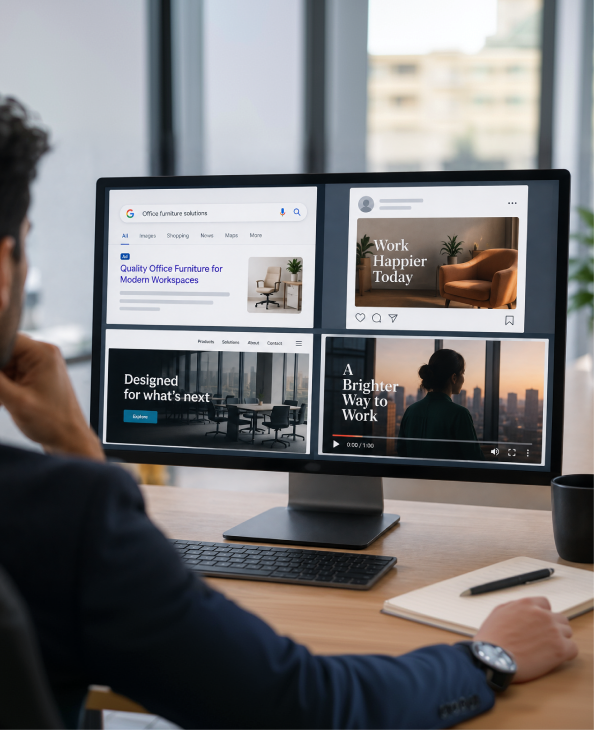
Every channel is writing its own company.
You may have this problem if:
- Every channel has its own headline, and none would survive off the slide.
- New formats keep arriving because last month’s set “needs refreshing.”
- Search, the feed, the page, and the film feel like four vendors.
- Sales cannot repeat the campaign line without looking it up.
- Nobody can say which fonts, tracks, or stock images are licensed, or until when.
- Results are reported by file name, so nobody knows which idea worked.
The damage is recognition that never builds. And one unlicensed track or unpermissioned client logo can pull a campaign in the week it starts working.
From a pile of formats to a system that compounds.
The assets are still assets. What changes is what they share, and what they are allowed to change.
| Today | What this program adds | Desired state |
|---|---|---|
| The brief is a list of formats | A one-page argument agreed by marketing and sales | Every asset carries the same thought |
| Each channel writes its own headline | One line, adapted for search, feed, page, and film | Buyers meet one company everywhere |
| A new look each quarter | Fixed assets, rotating executions | Recognition builds across flights |
| Proof dressed as atmosphere | Proof labeled as proof, with source and permission | Buyers can tell what is evidence |
| Licenses in someone’s inbox | A rights record with term and territory | No surprise takedown |
| Assets made with no destination | A job and a placement for every asset | Nothing is produced for the folder |
| Results by file name | Results by idea and by job | You know which thought worked |
| Sales has not seen the campaign | A sales version of the argument, in the deck | The line survives the meeting |
This is not a production service. It is the work of making one argument recognizable everywhere a buyer meets it.
System1 has tested B2B advertising with the LinkedIn B2B Institute since 2021, and across that work about three in four B2B ads earned the lowest effectiveness rating. A Gartner survey of 632 B2B buyers, published in June 2025, found that 69% had met inconsistencies between a supplier’s website and what its sellers said. Creative is where that gap is easiest to see. That is why Mplan agrees the argument before it produces a single format.
Eight checks
Eight things we check before media money goes behind the work.
Any one of these can undo the rest, so they come first.
- One argument. Marketing and sales have approved the same brief.
- Claims. Every result, client name, and quote has a source and a permission.
- Rights. Fonts, stock, music, talent, and AI material are licensed and recorded.
- Assets. The recognizable pieces are defined and the same on every channel.
- Destination. Every asset has a job and a placement.
- Specification. Contrast, captions, alt text, and safe zones pass for each platform.
- Ownership. Someone owns approvals, source files, and the asset library.
- Naming. Results can be read by idea, not only by file.
If one fails, it gets fixed before production volume or media spend goes up. The Programs page explains the method behind the checks.

























From tension to a system.
If the thought cannot survive a search headline and a film, it is not ready to produce.

Decide
Find the buyer’s tension and write the one-page argument.

Fix
Lock the distinctive assets, the proof rules, and the rights record.

Produce
Build the expression for each placement from the same brief.
Rotate
Refresh executions on a plan, read results by idea, review each quarter.
What a campaign system hands over.
Depending on scope, the work produces:
These are briefs, files, and records you can open. Not a mood board that says the brand feels stronger.
One-page argument brief
Distinctive asset rules: phrase, type, color, shape, image treatment
Proof and claims rules
Rights and license record
Search ad copy and landing page creative
LinkedIn and Meta feed units, static and video
Film scripts, edits, and cutdowns
Sales deck version of the argument
Asset library in Figma or Drive, with owners and usage rules
Naming system that reads results by idea
Platform specification and accessibility checklist
Refresh plan for executions that wear out
Fit and limits
When creative deserves a project of its own.

Works best when
The audience and the change you want can be stated, you already have an offer a buyer can choose, search, feed, page, or film will actually carry the work, and proof can be shown as proof or you will live without dressing it up.

Reconsider when
The offer itself is still moving, formats already exist and the missing piece is media rather than another execution, nobody can name the thought that should survive off the slide, or the next learning you need is a sales conversation, not a new size.
We do not guarantee recall, click-through, or sales effect, we do not give legal opinions on rights or claims, and we do not invent proof. Media buying sits under Paid Ads.
Questions
Questions companies ask before they brief the next campaign.
Do we need a brand book before campaign creative?
A stable offer and a clear buyer problem matter more. We use the brand system you have when it helps the argument travel. If the book and the argument fight, the argument wins for the campaign, and the conflict is written down instead of styled over.
What formats do you produce?
Search ad copy, landing pages, LinkedIn and Meta units in static and video, short film, and sales decks. Print and outdoor when the plan calls for it. Every format comes from the same brief, in the platform’s own specification.
How should B2B creative be evaluated?
First: can the intended audience repeat the argument? Channel response can pick a winner between two expressions inside a defined test. Click-through rate cannot tell you the company became more recognizable. If sales still cannot repeat the line, the test used the wrong scoreboard.
How do you keep proof from turning into atmosphere?
Permission first. Source and context stay attached. A result is labeled as a result and a product screen as a product screen. Licensed photography is atmosphere and is not asked to impersonate evidence. You should be able to point at any frame and say what is fact.
Do you use AI-generated images or video?
Where it serves the argument and the rights are clear. Every AI-generated asset is recorded like any other licensed material, and none of it stands in for a real product, a real person, or a real result.
What if we only need one placement this quarter?
Then the argument is still written as if the others will arrive. A search-only flight should not invent a line the landing page cannot keep. The unused expressions can wait. The distinctive assets should not need a redesign when film joins later.
Is this a one-off project or a retainer?
Two levels. The Minimum Program agrees the argument, locks the assets, sets the proof and rights rules, and produces the core expressions. The Performance Program keeps producing inside that system, with a refresh rhythm and results read by idea. A company whose system already passes the checks can start at Performance. The review decides.
When should we not produce more assets?
When the argument is unclear, when formats already exist without a coherent idea, or when the next learning needs a conversation and not another variant. More sizes will not rescue a thought that cannot survive a sentence.