
CREATE DEMAND · GOOGLE ADS
Turn high-intent searches into conversations sales will take.
A busy Google Ads account can still send sales people the business cannot use. The platform calls each one a conversion. Mplan concentrates spend on searches that already carry commercial intent, matches the landing page to the decision behind the query, and imports offline conversions so bidding hunts accepted conversations.

On this page
Desired change
Turn paid search activity into demand sales can actually use.
Google Ads can look healthy while the business sees something different: irrelevant queries, inflated brand conversions, form fills that go nowhere, and automation learning from weak signals.
The goal is not more conversions in the platform. It is a clearer path from valuable search intent to sales-accepted demand.

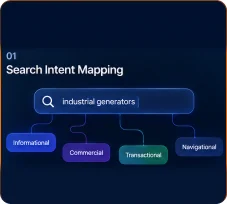
Find the Right Intent
Separate genuine category demand from brand traffic and irrelevant searches.

Continue the Intent
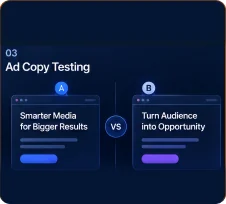
Make the ad and landing page answer what the buyer actually searched for.

Teach Google What Matters
Feed qualified and sales-accepted outcomes back into the account so bidding learns from business value, not form volume.
Capabilities
Protect the meaning of the search.
Protect the meaning of the search, so a query, a promise, a page and a sales outcome all describe the same decision. This is B2B search account work: structure, query control, landing match, and conversion meaning. The auction is Google. The job is yours. We keep the account pointed at commercially meaningful searches and at destinations that finish the answer the ad began.
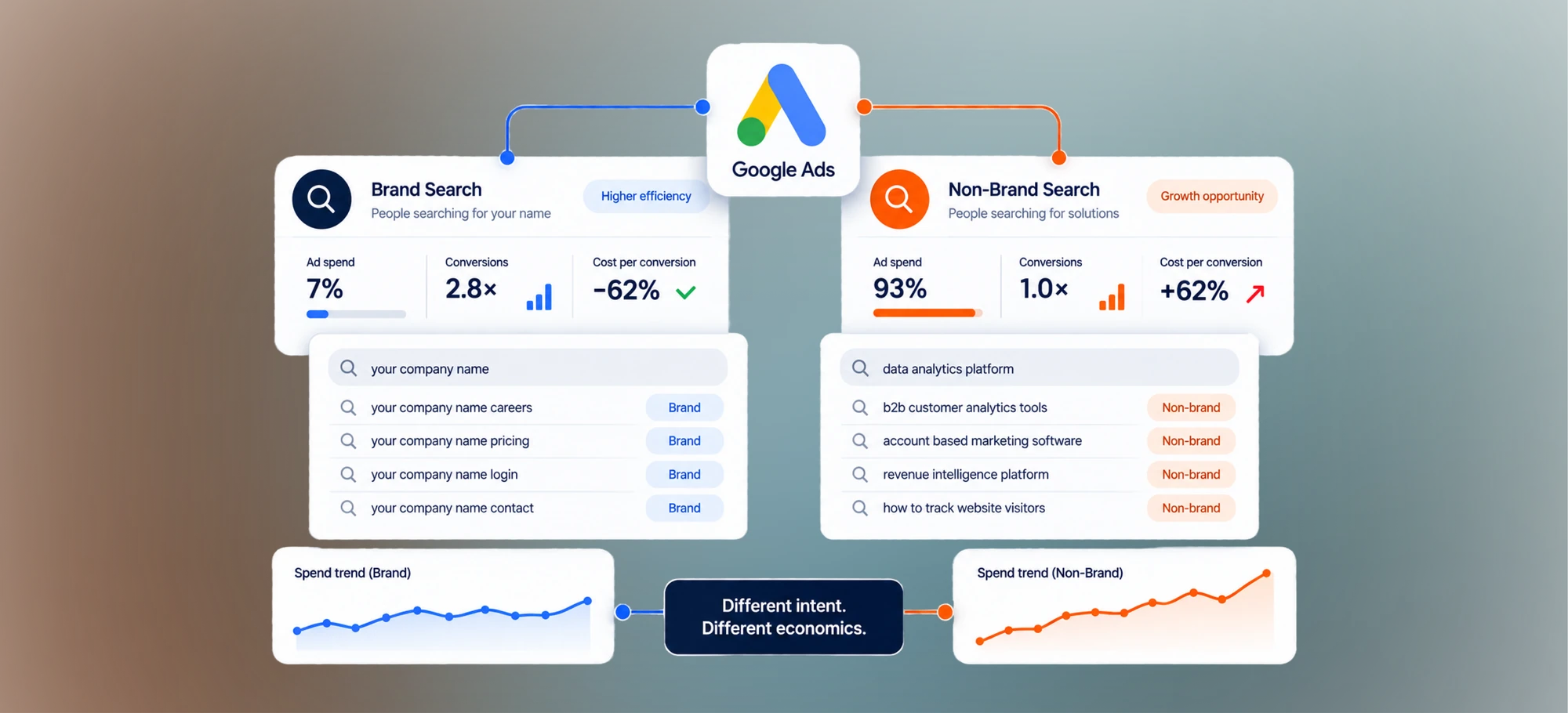
A click on your own name and a click on a category question have different economics. Dreamdata 2024 B2B Google Ads benchmarks found branded search takes about 7% of total ad budget and returns far more efficiently than non-branded search. Blend the two and the account looks heroic while the growth question disappears.
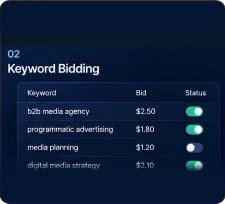
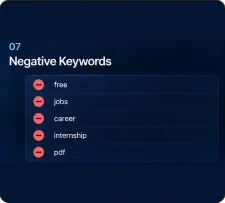
Keywords are instructions to an auction. Search terms are what people typed. Negatives remove students, careers, DIY, vendor and out-of-market language before those queries become a habit. Close variants and AI-expanded matching get the same scrutiny.
Comparison queries get decision guidance. Specific problems get specific answers. Brand demand often gets a direct route to contact. A generic homepage asks the buyer to reconstruct the offer alone.
Automated bidding finds more of whatever you call success. Feed it raw forms and it hunts forms. Feed it the inquiry sales accepted and it hunts those. The CRM definition has to be stable before the algorithm is trusted with more budget.
Intent is only useful when the next page answers it.
A query establishes the question. The advertisement frames a relevant promise. The landing experience must provide the matching explanation and next step.

Buyer question
Commercially meaningful search intent

Relevant promise
A message specific to that question

Useful response path
Context, proof and an appropriate action
Decision context
Where search budgets earn or lose their meaning.

The account is active. The inquiries are not a market
Search can look healthy from the office and feel useless in the CRM. Clicks arrive. Forms arrive. The people behind them do not look like the buyers sales already knows. The leak is usually in matching, the page, or the event you told Google to find more of. You may have this problem if:
- Brand and non-brand live in the same campaign, so the dashboard looks healthier than growth is.
- Nobody reads the search terms report unless a lead is obviously bad.
- Category, competitor, and problem queries all land on the homepage.
- Bidding optimizes to form fills sales later discard.
- Performance Max is on because it is supposed to find extra demand, and reporting got harder to explain.
- Expanding keywords feels like progress even after the useful queries are already covered.
The damage shows up in sales time, not only in wasted clicks. You pay twice: once in the auction, and again when the team works an inquiry that was never a buyer. That second cost is how a working account quietly taxes the pipeline.










Separate, read, match, teach
Turn high-intent B2B searches into conversations sales will take. Separate brand from non-brand, match the page, and import offline conversions.

Separate
Brand, category, competitor, & problem demand get their own structure & their own scoreboard.

Read
Search terms, negatives, & inquiry quality are reviewed on a weekly rhythm.

Match
Each valuable query class gets a page that finishes the same decision.

Teach
Offline conversions guide bidding to find more valuable conversations. Expansion is considered only after.
From platform activity to search the business can actually judge
Google Ads reports what happened inside the platform. The business needs to know which searches created useful demand, which signals deserve more budget, and which activity should be removed.
| Platform activity | Search with commercial meaning | Why it matters |
|---|---|---|
| Brand and non-brand conversions blended together | Brand and category demand reported separately | Shows whether growth comes from existing awareness or new demand |
| Keywords treated as proof of intent | Actual search terms reviewed every week | Reveals what buyers really searched and where spend is leaking |
| Irrelevant queries allowed to accumulate | Low-value intent excluded with negatives | Protects budget from careers, students, DIY and other poor-fit searches |
| Every click sent to the same destination | Landing experience matched to the query | Continues the buyer's intent and gives them the right next step |
| Every form counted as success | Forms, qualified inquiries and accepted conversations kept separate | Distinguishes activity from genuine commercial opportunity |
| Bidding trained on platform conversions | Sales-accepted outcomes returned from the CRM | Gives Google a stronger definition of what success actually means |
| Automation expanded because CPA looks healthy | Automation scaled only after the signal is trustworthy | Prevents weak conversion data from being amplified by more budget |
What lands in the account and the log
Depending on scope, the work produces:
You can open the Google Ads account and the log and see the decisions. You should not need a narrative to reconstruct them. If a change cannot be found in the weekly log, it did not happen.
Brand and non-brand account architecture
Query themes with match-type and negative logic
A weekly search-term and negative-keyword log
Landing-page match notes by query class
Conversion taxonomy agreed with sales
Offline conversion import setup and QA
Performance Max go or no-go criteria
Brand-bid test design where volume allows
Reporting that keeps cost per accepted conversation visible
Fit and limits
Match the landing page to the decision behind the query.

Works best when
Match the landing page to the search decision. A category query, branded query and specific problem each deserve an answer suited to their intent.

Reconsider when
Keep expansion modest while important queries lead to a generic answer or the business cannot tell a suitable inquiry from an easy conversion.
Decision guidance
When Google Ads deserves the central role.
Google Ads deserves the central role when buyers already search for the problem, the category or named suppliers, you can tell a useful inquiry from an easy form fill, and sales will help define an accepted conversation.

Search reflects the demand that already exists in the market. Capture media cannot create a market that is not typing yet.
Additional budget can move toward weaker queries once valuable demand is covered.
Negatives and the brand split can change the account in the first weeks. Offline import depends on CRM hygiene, and bidding needs a stable learning window after the signal changes.
Questions
Before you scale the search account.
Why does a busy account still produce weak pipeline?
Because the account optimizes toward whatever it was told to call success, usually raw form fills. Search terms, the companies behind inquiries, and what sales accepted show whether the activity is a market or just matching language. Fix the conversion signal and most of the noise drops with it.
Should we bid on our own brand name?
Test it. When competitors sit on your name, defense usually pays. When nobody does, a large share of that traffic was arriving anyway. Separate brand and non-brand reporting so the answer stays visible. Run a holdout where volume allows. Do not fund brand clicks because they make ROAS look kind.
When is Performance Max right for B2B?
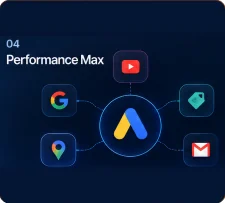
After the account has a trustworthy conversion signal and brand exclusions in place. On that base it can extend reach. Switched on early, it optimizes toward cheap actions the business cannot use, and the reporting makes the damage slow to notice. We treat PMax as an expansion layer, never as the place you hide an unread search account.
What should a founder see in the report?
Search-term quality, brand and non-brand performance separated, cost per accepted conversation, and what changed since the last review. Platform dashboards are input. They are never the verdict. If the report cannot explain a week of spend in those terms, it is a screenshot, not management information.
Do we need new landing pages for every keyword?
No. You need a page for each decision class: brand, category comparison, specific problem, competitor alternative. Ten near-duplicate pages help nobody. One homepage for every query helps the auction more than it helps the buyer. Build the missing class before you build the twentieth variation of the same class.
How do you handle AI-generated assets and broad matching?
As hypotheses. Generated headlines and expanded matching can find useful language. They can also spend on questions you never intended to answer. The weekly search-term read is the control. Anything the business would not want to rank for organically should not keep paying in search.
When should search step back?
Once the valuable queries are covered, extra budget slides toward weaker intent. If buyers do not yet understand the category, content, paid social, or account work has to create demand before search can capture it. We will say so instead of inventing more keywords. Capture media cannot create a market that is not typing yet.
Can you manage Google Ads for a US market from India?
Yes. Campaign structure, intent and conversion imports follow the market you buy in; strategy and optimization sit with our team in Bangalore. You get named owners and a change log.