
CREATE DEMAND · PAID ADS
Give every paid channel one job in one journey.
Search reports conversions. Social reports engagement. Programmatic reports reach. None of that tells you what the buyer understood. Mplan gives each paid channel one commercial job inside one journey: capture demand that already exists, or create it among people not yet looking. The landing page continues the same argument after the click.
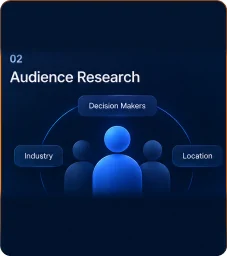
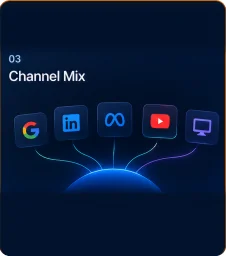


On this page






Desired change
One journey. One job per channel. One argument that survives the click.
Your channels are busy. Each platform is doing work, and almost none of it is doing the same work.
One journey, one job per channel, and one argument that survives the click, so capture and creation are planned as different jobs and the destination keeps the promise the ad made.
Capabilities
What paid media at Mplan actually covers.
Paid media here means planning, buying, and judging Google Ads, Meta Ads, LinkedIn Ads, and programmatic as one system. Some channels capture demand. Some create it. They are never given the same job. The work starts with the decision the buyer is making, then assigns media, creative, and the landing path around that decision.
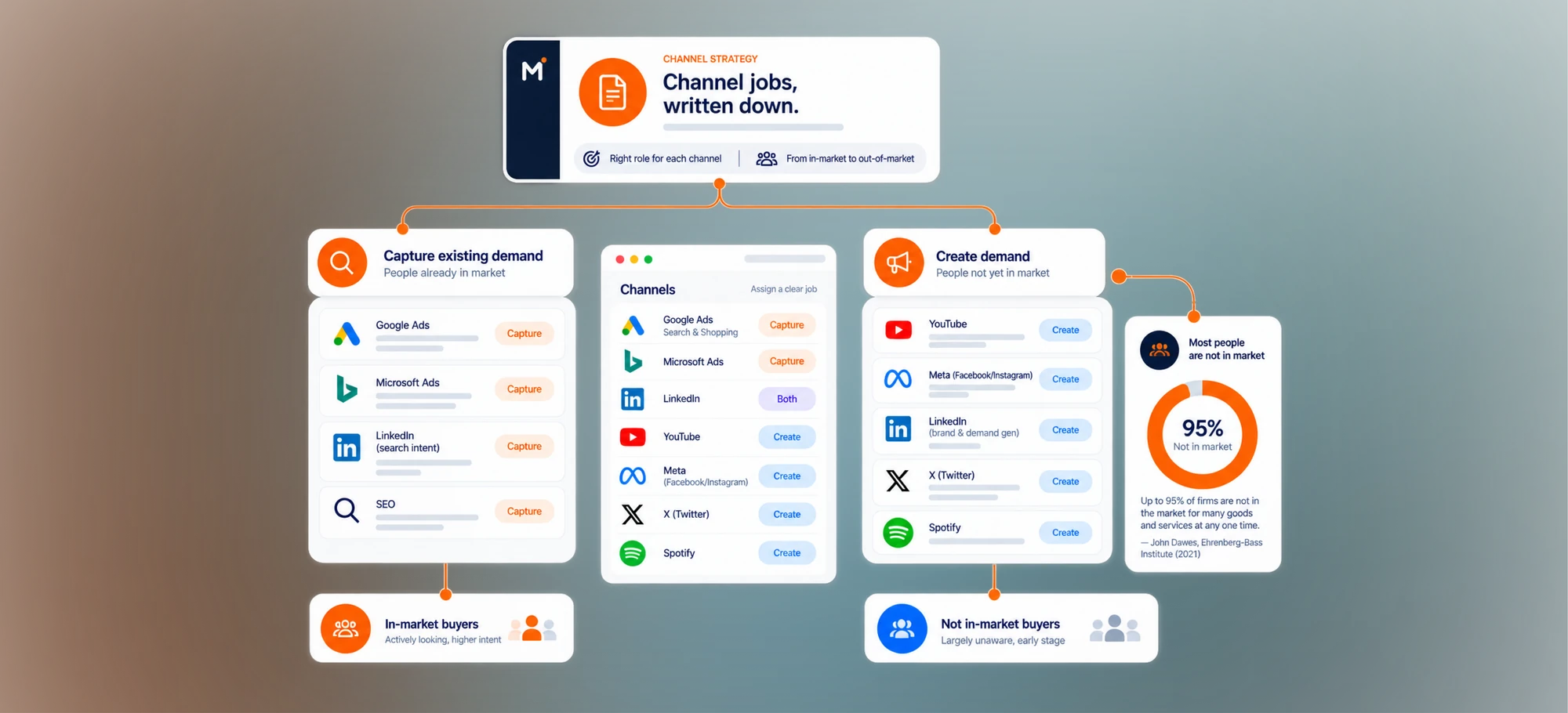
Every channel gets one job in writing: capture existing demand, or create demand among people not yet in market. John Dawes at the Ehrenberg-Bass Institute (2021) put the split in hard terms: up to 95% of firms are not in the market for many goods and services at any one time.
A channel stays only if it can still reach a valuable audience, carry the idea, and produce evidence that can change a decision. Thin audiences and unreadable signals are reasons to leave a platform out. A smaller plan is often the first improvement.
The visit is wasted if the page feels like a different campaign. Someone searching for a supplier may be ready to compare and talk. Someone meeting a new market idea needs context first. Asking both people for the same form throws the signal away.
A click, a view, a form fill, and a sales-accepted conversation are different facts, so the labels stay intact. Where the spend justifies it, we hold back a region or an audience and measure what the media actually caused.
Different media jobs should support one commercial idea.
Demand creation, active intent and the response experience require different decisions. They become coherent when the same argument survives between them.

Create familiarity
Social and programmatic

Capture active intent
Search and relevant paid response

Continue the idea
Creative, landing experience and handoff
Decision context
What changes, and how the mix gets judged.

Your channels are busy. The journey is still incoherent
A paid plan can look complete on a slide and still fail the buyer. Each platform is doing work. Almost none of it is doing the same work. You feel this first in reporting meetings, then in sales calls that start from scratch. You may have this problem if:
- Google Ads, Meta, LinkedIn, and display all run, and none of them share one argument.
- Search looks profitable because brand queries pad the dashboard.
- Social volume is high, and sales cannot name a useful conversation that came from it.
- Programmatic reports impressions, and nobody can say what those impressions were for.
- Each platform has a different conversion event, so the same buyer is counted three times.
- Expanding spend feels easier than deciding which channel should stop.
The commercial cost is not only wasted media. It is a market that meets a different company at every turn, and a leadership team that cannot tell activity from progress. Budget then follows the loudest dashboard instead of the broken step in the journey.










Assign the jobs, then buy
Give every paid channel one job in one B2B journey. Capture demand on search. Create demand on social and programmatic with one argument.

Map
Existing demand, the audiences that still need familiarity, and the break in the current path.

Assign
One job per channel, one argument, and a landing path that matches readiness.

Buy
Search, social, or programmatic only where the job is honest.

Judge
Keep platform reports as input. Use incrementality, accepted conversations, and creative learning as the verdict.
Priorities differ by company. The sequence does not. Jobs first. Purchase second. A channel that cannot be assigned an honest job does not enter the buy, even if the team already has logins.
From channel activity to a media plan that can be judged
| Channel-first today | Journey-first approach | What changes |
|---|---|---|
| Channels compete for credit | Each channel gets one defined job | Performance can be judged against its actual purpose |
| Brand search disguises the wider mix | Capture and demand creation stay separate | Existing demand is not mistaken for newly created demand |
| Every platform defines its own success | The business defines meaningful outcomes | Platform metrics stop dictating commercial decisions |
| Views, clicks and forms become “conversions” | Signals keep their original meaning | Attention, response and real opportunity are not confused |
| Every channel stays in the plan | Channels must earn their place | Thin audiences and unreadable signals become reasons to exclude |
| Landing pages restart the conversation | The campaign argument continues after the click | Buyer intent is preserved rather than lost at the landing page |
| One creative idea is repeated everywhere | Creative is adapted to the channel's job | Each medium contributes differently to the journey |
| Last-click gets the credit | Incrementality is tested where justified | Decisions are based more on what media caused, not just what it touched |
| More channels make the plan look stronger | A smaller, clearer mix is acceptable | Budget concentrates where useful evidence and audience quality exist |
What the media plan puts on paper
Depending on scope, the work produces:
These are documents you can inspect in a working session, not a slide that says the mix is working. If a founder cannot point to the job, the destination, and the stop rule, the plan is not finished.
A written channel-job map for search, social, and programmatic
Conversion taxonomy the business and the platforms both use
Capture versus creation budget split, with reasons
Creative test plan that compares market ideas
Audience and exclusion rules per channel
Incrementality or holdout design where spend justifies it
Landing-continuity notes by intent and readiness
A stop rule for any channel that cannot do its job
Weekly or monthly readout that keeps each signal in its own column
Fit and limits
The landing experience decides what the click was worth.

Works best when
Plan the post-click experience before buying reach. The landing experience should continue the campaign idea, present relevant proof and offer a next step suited to the buyer’s intent.

Reconsider when
Give media a smaller role while the destination remains generic, essential proof is unavailable or the page cannot support the decision the campaign promised.
Decision guidance
How the first media mix gets chosen.
A paid-media rebuild earns priority when the offer is clear enough to write one argument across channels, you already spend on more than one platform, and sales can say what a useful conversation looks like.

Auction, policy and identity changes sit outside the agency’s control.
A platform attribution view describes only the evidence available inside that platform. Reach, response, accepted conversations & incrementality stay in separate columns.
Account cleanup and job assignment happen in the first cycle. Incrementality needs a planned window, not a week of dashboard watching.
Questions
Questions companies ask before rebuilding paid media.
How do you decide which paid channels belong?
Start with demand that already exists, the audience that still needs to recognize you, cycle length, and the idea the market must understand. Google Ads captures active search. Meta, LinkedIn, and programmatic create demand in different ways. A channel enters only when its job and its next step are clear. It leaves when it cannot reach the market, cannot carry the idea, or cannot produce evidence you can use.
How should a long B2B cycle be judged?
Early evidence is reach, attention, and response inside the intended market. Later evidence is accepted conversations and opportunities the business records. Platform attribution stays input. Where the budget is large enough, we test incrementality directly by holding back a region or an audience. Each signal keeps its original name so a late search click cannot take credit for months of recognition work.
Will you manage the current accounts or rebuild them?
Either can be right. Structure stays when it already reflects jobs, audiences, and conversion definitions the business recognizes. Rebuilds win when the accounts are a patchwork of old tests that no longer match the commercial argument. We will say which case you are in before buying more inventory. Keeping a messy account to preserve history usually preserves the same confusion.
When should paid media pause entirely?
Pause when the offer is unstable, the step after interest is broken, or nobody can continue the story the market just heard. Busy media is not useful if the company cannot finish the conversation. In those cases the next dollar belongs in the offer, the page, or the reply a buyer receives, not in another auction.
Why not judge everything on ROAS?
Because most B2B journeys touch more than one channel, and last-click ROAS rewards the channel that stood nearest the form. Creation media will look expensive under that rule even when it made the later search possible. Use return figures where the path is short and the conversion is trusted. Use incrementality and accepted conversations where the path is long.
Do we need every channel to start?
No. Many companies should run search plus one creation channel until the argument and the landing path are stable. Adding programmatic before those foundations exist buys unreadable reach. A two-channel plan you can judge will beat a five-channel plan you can only decorate with dashboards.
What does weekly work actually look like?
Search terms get read. Creation flights get checked for delivery quality, frequency, and whether the idea is still landing. Landing paths get compared to the ads that feed them. Anything that cannot be tied to a job gets questioned. The meeting is about decisions, not a tour of five dashboards.