
AI SEO
Reading AI Answer Movement Without Inventing Certainty.
- Written by
- Parag Masteh, Founder, Mplan
- Published
- Updated
You read AI answer movement honestly by re-running a fixed prompt set on a schedule, logging environment and date, and describing patterns rather than claiming control. A single favorable screenshot is not a trend. A repeated method on stable questions is the only observation worth reporting upstairs.
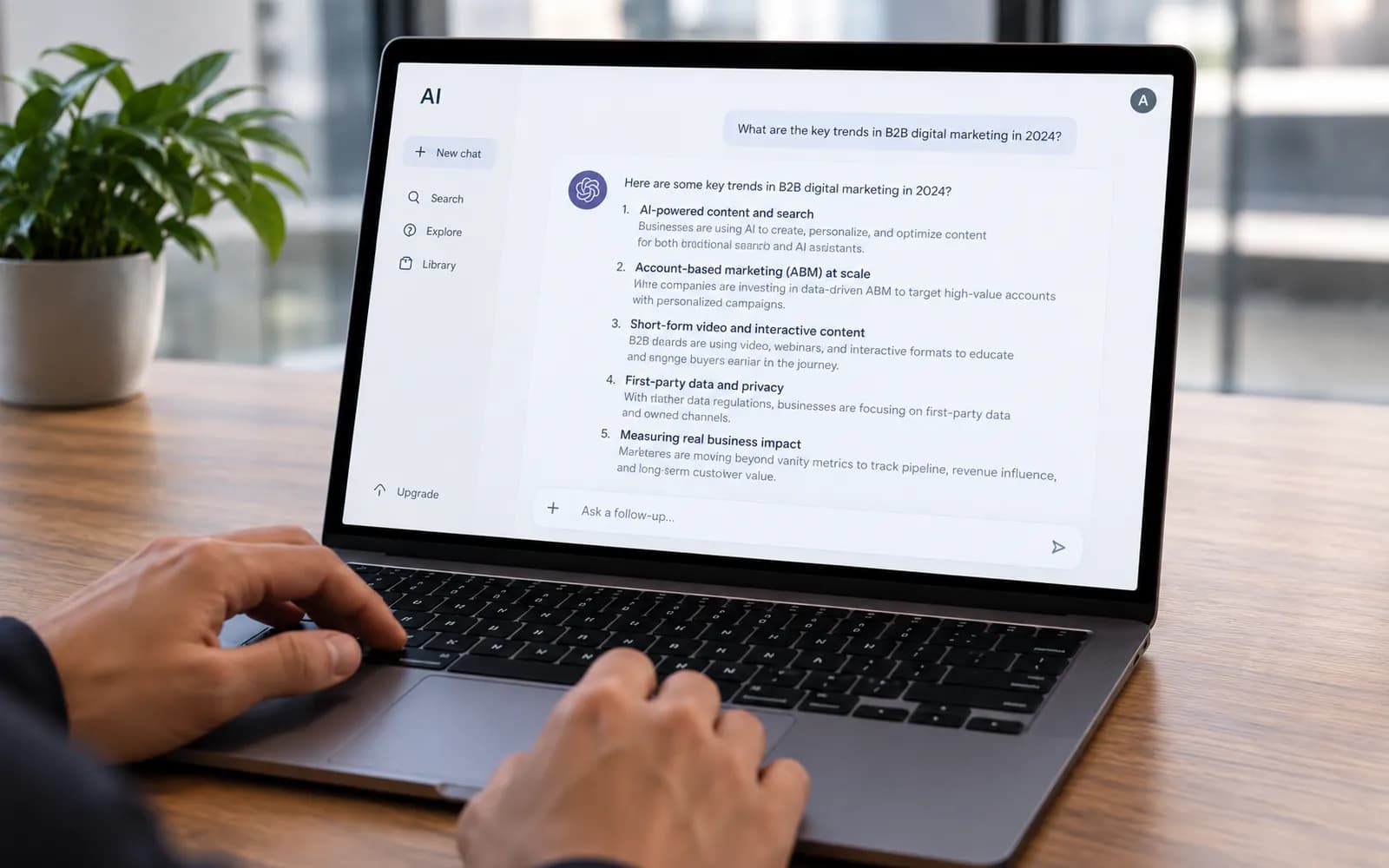
Boards like graphs. Generative answers hate graphs. They vary by model, session, location, and time. If you report them like ad ROAS, you will either overclaim or lose trust when the line wiggles. The fix is measurement design, not a prettier dashboard.
What you can observe
- Presence: are you named on a given prompt in a given run?
- Description quality: accurate, partial, wrong, or absent.
- Cited sources: which domains the system points to when visible.
- Relative set: which peers appear when you do not.
- Direction over time: whether the pattern changes across repeated runs on the same set.
What you cannot observe with certainty: causal proof that one page change produced one answer, person-level influence on a named buyer, or a universal "share of AI voice" that works across tools.
The minimum method
Lock a prompt set and choose a repeatable cadence that matches the decision. Record the tool or model family, date, and the fields above. Store the raw notes where finance and sales can inspect the method. A green summary slide is not evidence.
Separate brand prompts from shortlist prompts. Mixing them produces a fake average. You can look healthy on brand checks while remaining invisible where shortlists form.
How to talk about movement
Use language that matches the data. State the fixed prompt set, run dates, model or environment, exact observed counts, and what changed. Do not convert a small change into a dramatic percentage headline or imply that the marketing team caused the answer.
Pair machine observations with human ones. Sales may hear a new source named on calls. Buyers may arrive with a more accurate understanding of the offer. Those signals do not prove a clean attribution path. Together with the prompt log, they can show whether discovery quality is improving.
What not to do
- Do not change the prompt set between runs and then celebrate "improvement."
- Do not average unlike tools into one index without stating the mix.
- Do not screenshot only wins.
- Do not present model behavior as a contractual KPI.
- Do not ignore wrong descriptions. Being named incorrectly is a defect, not a vanity win.
Where the method loses certainty
Methods age. Tools change. A perfect log from last year can mislead if buyers moved to a different assistant. Review the prompt set when sales language changes, not when a vendor launches a new feature page.
Where this sits in the wider system
Honest AI measurement protects paid and outbound from false blame. If assistants misstate your category, ads and emails inherit a harder story. If assistants describe you accurately, other channels inherit a cleaner first impression.
Questions, answered
How often should we re-run the set?
Choose a cadence that can reveal a pattern without turning answer variation into busywork. The right interval depends on publication activity, market change, and the team’s ability to inspect raw answers.
Should we pay for a specialized AI visibility tool immediately?
Not until the prompt set is commercially meaningful. Tools scale capture. They do not invent the right questions. Start manual, then automate what you trust.
What if answers contradict each other across tools?
Report them separately. Contradiction is data. Forcing one score hides the real story buyers may see depending on the tool they use.
Can we set a target for the share of prompts that name us?
You can set an internal ambition. Treat it as a research goal, not a promise of control. Targets should sit next to the method and the known variance, or they become fiction.