
Paid Media
Founder-Led vs Company Page: Who Should Carry the Argument First.
- Written by
- Parag Masteh, Founder, Mplan
- Published
- Updated
Use a founder or practitioner profile for timely judgment and a company page for durable, approved facts, when those roles match the people available. The split is an editorial operating choice. It does not assume every market favors personal accounts.
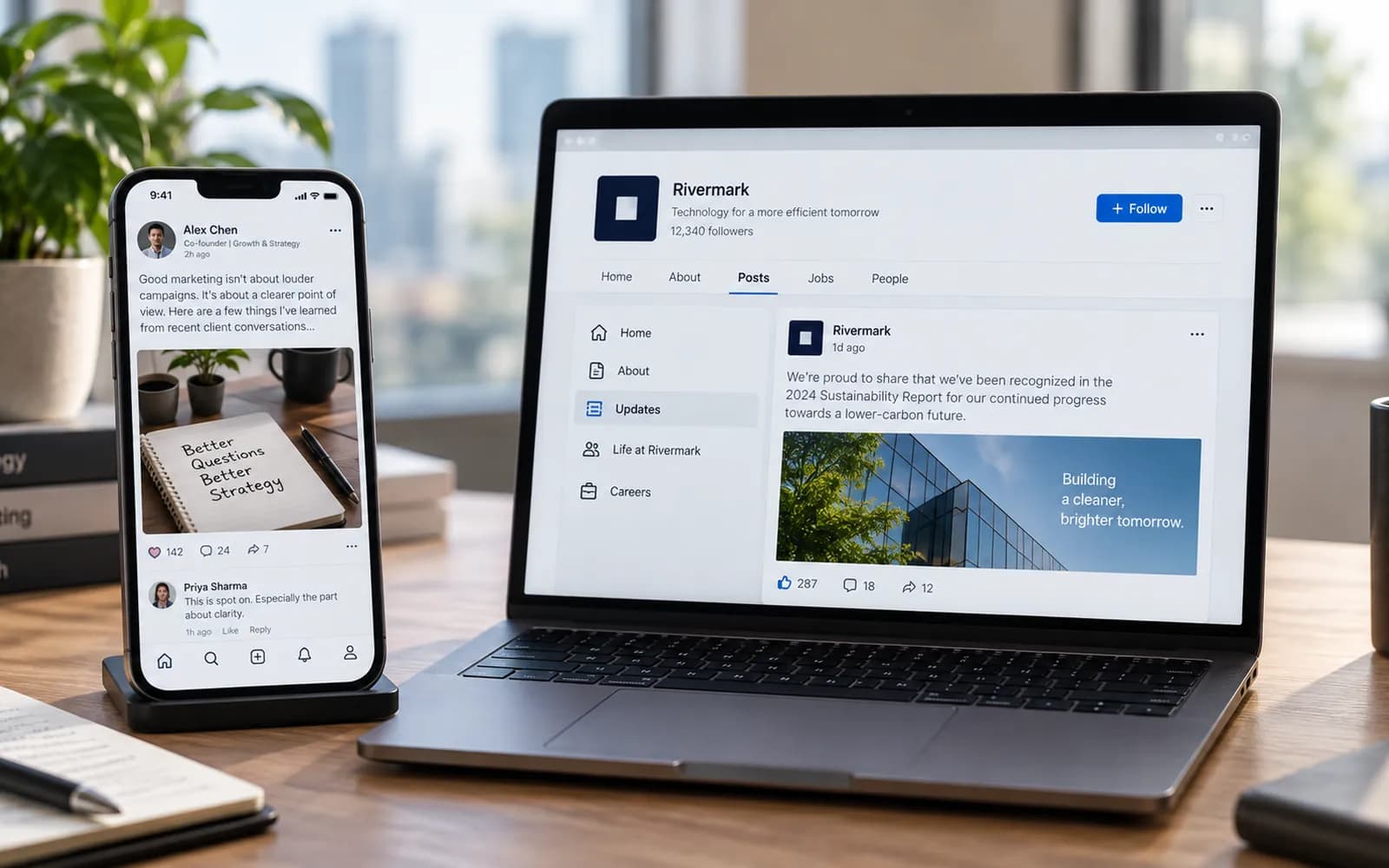
Do not assume either surface will carry the argument by default. A company page without useful facts stays thin. A founder profile without a durable company record leaves the buyer with nowhere to verify the claim. Split the jobs deliberately.
What the company page is for
- Official facts: what you do, for whom, where, how to contact.
- Proof you are allowed to publish.
- Hiring and culture signals that must be institutional.
- A stable destination when someone checks the logo.
What founder or expert profiles are for
- Point of view on decisions buyers face.
- Narrative from real work without leaking secrets.
- Conversation and replies that sound human.
- Distribution through the professional networks those people have earned.
If only one surface can be strong this quarter, choose by where expertise and review capacity sit. Then make sure the other surface does not contradict it.
A simple operating split
Founder posts ideas and observations. Company page posts proof, product truths, jobs, and selected amplifications of founder ideas with context. Cross-link without turning every post into a funnel sticker.
When multiple experts post, agree on claims standards. Free-for-all opinions that conflict with sales promises create internal risk.
Assign claims to the person who can defend them
A founder can make a judgment about the market. A practitioner can explain how a difficult decision works. The company page should state durable facts, approved proof, and institutional commitments. Moving every claim through the logo removes useful authorship and makes corrections harder.
Build a handoff between the two surfaces
When a personal post introduces an important argument, the company should have a stable page or approved artifact that substantiates it. When the company publishes proof, the people involved can explain the decision in their own words. The handoff creates depth without copying the same caption everywhere.
When the split fails
Founder-led social fails if the founder will not show up. It also fails if legal forbids any voice. Design for the constraints you actually have.
Questions, answered
What if we have no charismatic founder?
Use practitioners with real expertise. Charisma is optional. Specificity is not. A sharp operator beats a polished empty executive brand.
Should employees all post the same content?
Shared themes help. Identical copy looks engineered. Give people room to sound like themselves inside claim rules.
Do company pages still matter for SEO or AI?
They matter as part of the public record and for official facts. Distribution depends on the platform and audience. Keep the company page accurate even when personal profiles carry more commentary.
How do we avoid founder burnout?
Lower frequency and raise substance. Batch notes from real meetings and support them with light editing. Do not build a broadcast schedule nobody can sustain.